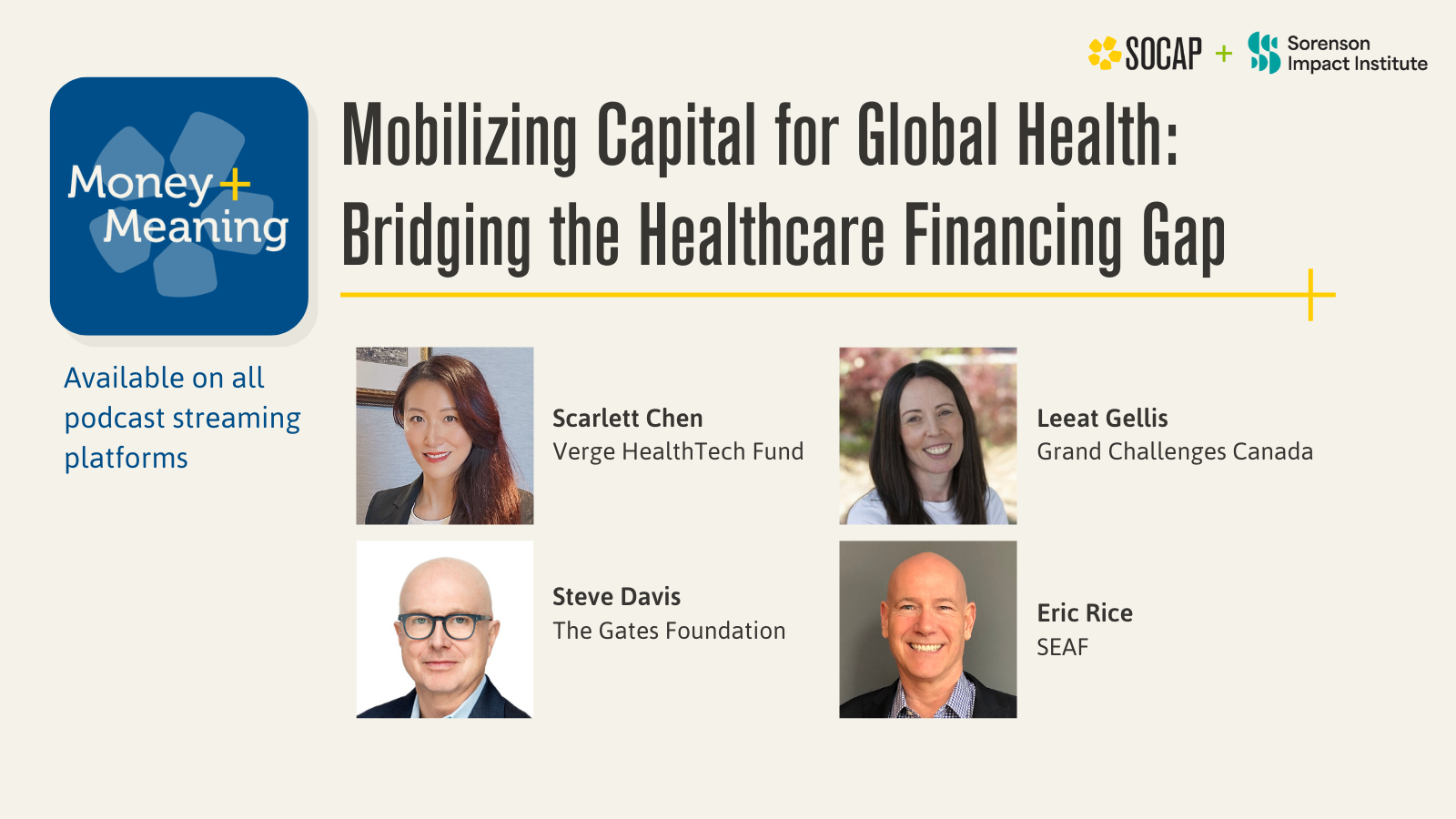

A Money + Meaning Podcast Episode on How Investors Can Collaborate to Mobilize Private Capital to Improve Global Health Outcomes
Bridging the healthcare financing gap by mobilizing private capital through sustainable financing alongside public funds is essential to achieving universal health coverage and SDG3 by 2030. The U.S. withdrawal from the WHO and retreat from investing in the global health enterprise this year have added to this gap, with long-term predicated ramifications on disease transmission and a loss in global public health infrastructure. The role of private capital working in collaboration with multiple stakeholders is at a critical juncture for action.
In this episode of Money + Meaning, recorded at SOCAP24, listeners will learn about successful impact investment case studies in global health, including in low- to middle-income countries. You’ll hear about the panelists’ proven innovative financing solutions and dive into the critical and remarkable potential for technology, “health tech,” and AI in scaling global health care solutions.
“Our plan is to take more risks,” said Leeat Gellis, Director, Social Finance at Grand Challenges Canada. “We’ve just completed a risk assessment and come to the conclusion that we’re not taking enough risks, and we’re the ones that should be doing it.”

Listeners will also gain an understanding of the G7-led Impact Investment Initiative for Global Health (Triple I for GH) and learn about opportunities for collaboration among a wide range of international health investors and ecosystem players, with a focus on achieving the goals of the Triple I for GH. You’ll leave the conversation with important calls to action to drive forward solutions for global health.
The leaders featured in this podcast episode:
- Scarlett Chen, Managing Partner, Verge HealthTech Fund
- Steve Davis, Senior Advisor and Interim Director of the Philanthropic Partnerships Team, The Gates Foundation
- Leeat Gellis, Director, Social Finance, Grand Challenges Canada
- Eric Rice, Managing Director, Impact Investing, SEAF (moderator)
What is Triple I for GH trying to achieve?
Triple I for GH is a G7 initiative aiming to accelerate private sector financing through impact investment in global health innovation and system strengthening, particularly in developing economies. To support this effort, Triple I for GH aims to foster collaboration, share best practices, and raise awareness of different stakeholders’ roles in impact investing for global health.
Steve Davis, who is also a co-chair on the Triple I for GH, said, “…the goal is to accelerate more social impact investing into global health.” He named the biggest initial issue the Triple I for GH aimed to tackle as getting better visibility around social impact investing in global health. He shared that the current two-year focus is on three points:
- Profiling use cases and stories to build confidence in the sector
- Measurement of the social impact of global health investments
- Identifying the role of governments to help accelerate these investments
“We’re focused on moving the needle in low- to middle-income (LMI) regions,” Davis said. “We’re trying to shine the spotlight on some of the most interesting investments that have actually moved the needle on health outcomes in those regions, understanding what the construct was around that investment in terms of what the government needed to do, what maybe philanthropy did, or what other kinds of participants in the vehicle or the investment mechanism did.”
(Note: Since the recording of this conversation, Triple I for GH has published its policy recommendations.)
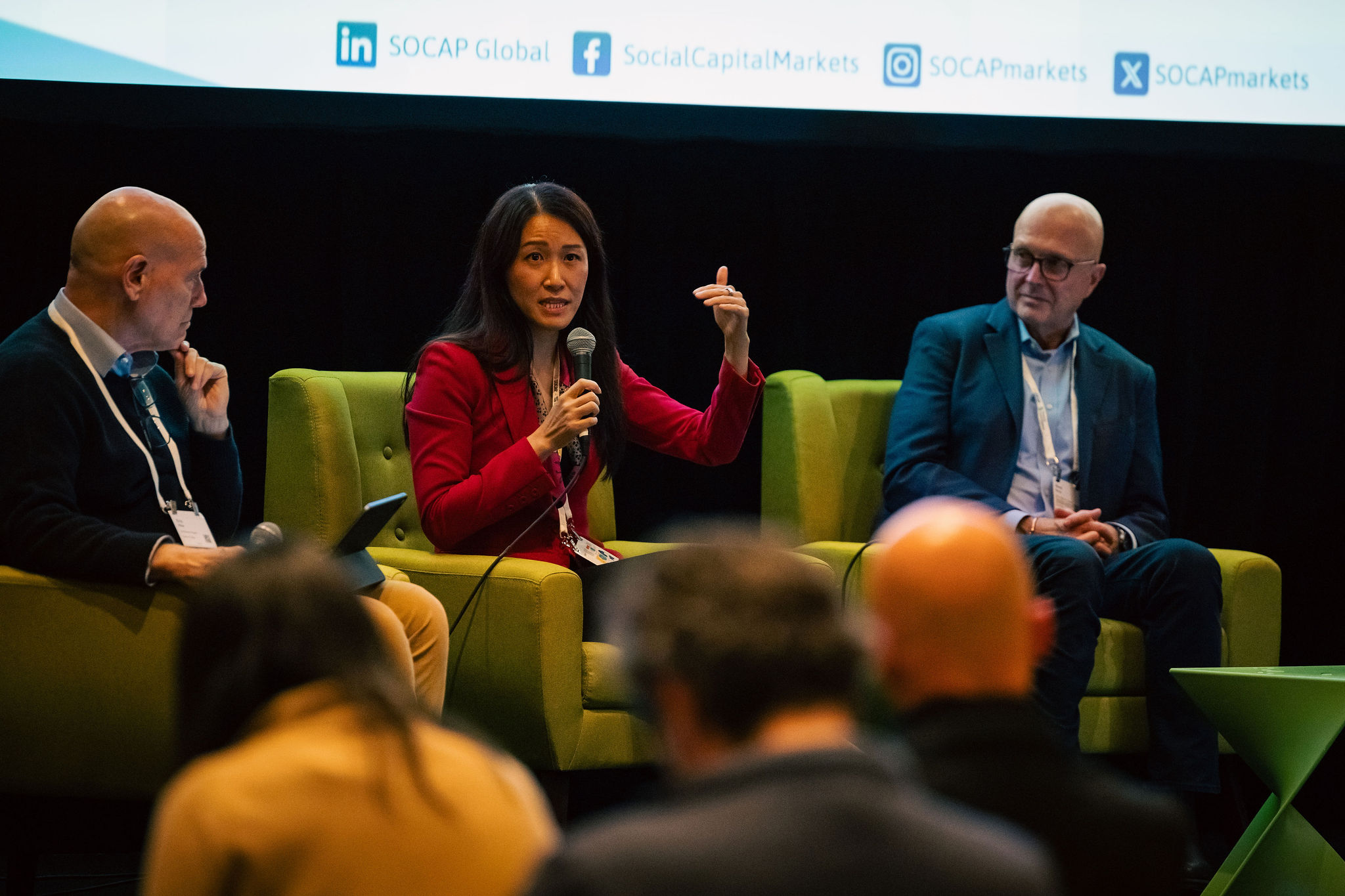
How do you identify health care investments with good financial returns and powerful impact, especially in low and middle-income countries?
Scarlett Chen said that the Verge HealthTech fund starts with an impact assessment, focusing on three key areas, as a marker for a business that they can see as having a 10x return in the future. The fund also focuses on scalable “health tech” investments that can amplify the current health care resources around the globe, especially in LMI countries.
“The impact assessment is the first assessment that we do. Impact needs ot be integrated into the business,” Chen said. “This impact assessment is actually a very good business assessment, because if you are addressing these three key issues — access, affordability, and quality — then you are a meaningful and relevant business within healthcare. If you’re not addressing this, what you’re working on might not be large or significant enough going forward.”
Davis said there is also a necessary mindset shift around seeing LMI countries as a potential growth market. “These are markets in which the middle class is continuing to grow, and that means there’s more opportunity for low- to middle-income countries to become consumers of goods and services that these companies can provide.”
He added that, from the perspective of The Gates Foundation, they see opportunity to “crowd more private capital into health and development capacity-building into LMI countries in the world,” with a predicted advance in digital and tech applications in these regions.

What examples of scalable investments in global health solutions are you excited about?
The panelists shared examples of the companies they have brought into their portfolios that drive health outcomes with scalable models. Two examples of those shared:
“One tangible example of innovations in our portfolio at the intersection of gender lens investment and health, and climate and health. In Pakistan, we’ve invested in a telemedicine platform that seeks to connect health care services with people in rural and conflict areas,” said Gellis. She said this is an innovative model because it is tapping into a resource of women doctors who, for social or cultural reasons, are not practicing and are staying home.
“These women doctors are now at home providing telemedicine services to individuals and families across Pakistan, with plans to expand to UAE and Saudi Arabia, where you find a similarly untapped pool of available doctors.”
Chen provided an example of Reach 52 based in Singapore, which has an innovative model that started in an LMI country and is now scaling to higher-income countries. “They have rural villagers as healthcare workers who can actually bring the last mile delivery of healthcare services into rural villages, where people simply don’t have access to very basic things like health checkups and vitamins,” Chen said. The company has impacted more than 6 million lives alongside strong returns.
Hear about more incredible examples and ways investors and contribute at a critical time to meet global health needs. Learn more in the full conversation.
Don’t miss out! Subscribe to Money + Meaning on Apple Podcasts, Stitcher, TuneIn, Spotify, or anywhere else you find podcasts.
Listen to more episodes of Money + Meaning here.