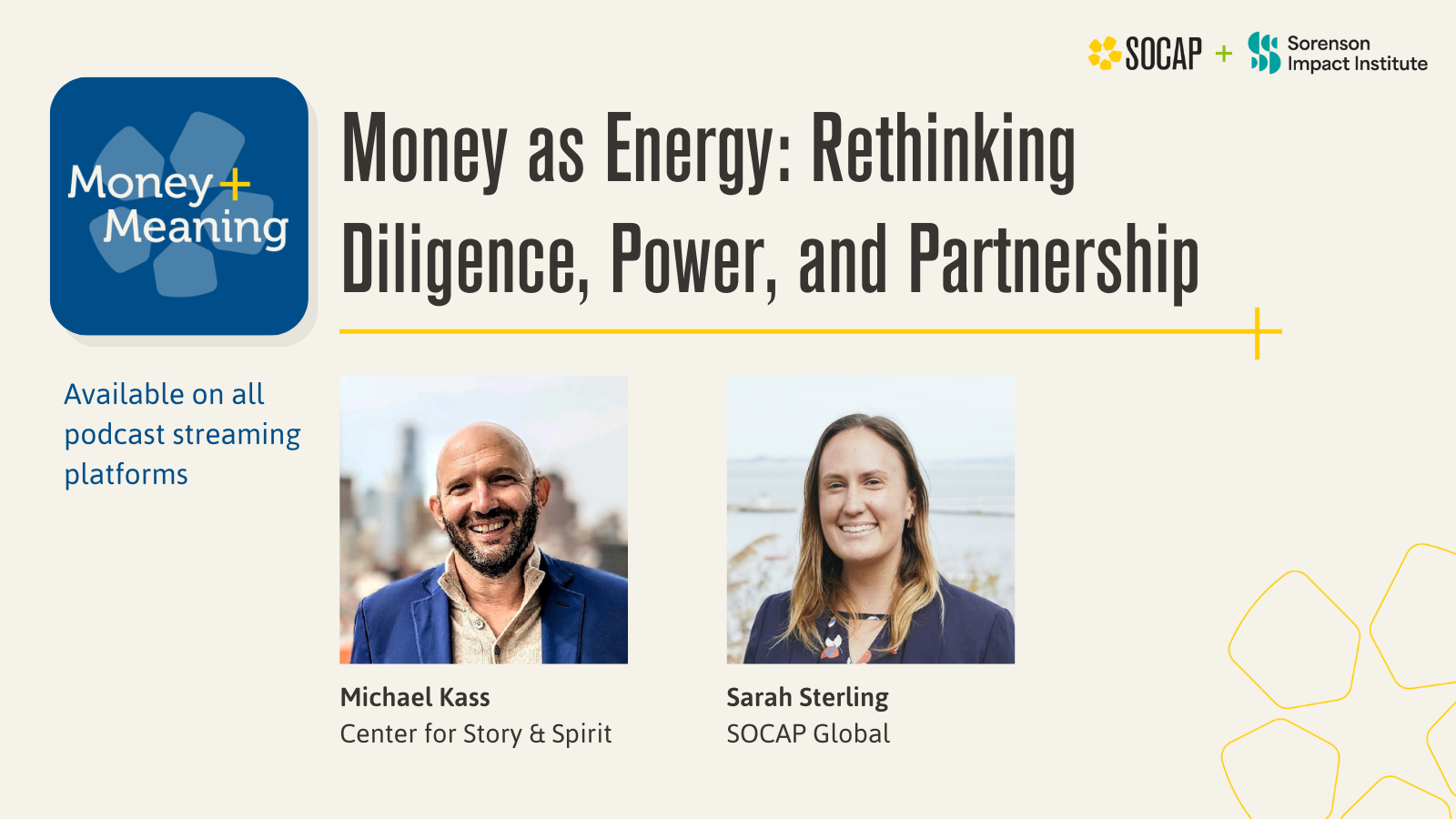

A Money + Meaning conversation with Sarah Sterling of SOCAP and Michael Kass of the Center for Story and Spirit
Impact investing often centers on models, metrics, and capital stacks. But as facilitator and coach Michael Kass shared in conversation with SOCAP’s Sarah Sterling, outcomes are also shaped by the stories organizations live inside, the trust within teams, and the relationships among founders, funders, and boards. By treating money as energy and expanding due diligence to include culture and capacity, investors and entrepreneurs can design partnerships that create systemic, lasting change.
A new Money and Meaning episode explores how narrative alignment, right-sized growth, and co-created reporting can make deals more resilient. Find excerpts below from the conversation featuring:
- Michael Kass, Founder, Center for Story and Spirit
- Sarah Sterling, Executive Director of SOCAP Global
Kass began by mapping three layers of story that influence execution: the stories people tell themselves, the stories teams tell each other, and the larger sector narratives they operate within. When those layers align, said Kass, organizations move with less friction; when they don’t, even sound business plans could stall. “Systems are, in essence, stories we’ve agreed are true — then built structures to support,” he said.
The discussion also challenged the default assumption that every promising venture should scale outward. Kass suggested asking whether a venture actually wants to scale wider or root deeper into community and expertise. Misaligned pushes to scale often surface as burnout and trust breakdowns. “Growth reveals all the fractures in a culture,” he noted, adding that capital without cultural repair tends to amplify existing cracks.
To help investors evaluate those dynamics, Kass proposed adding an “energetic balance sheet” alongside financial diligence — looking at human capacity, trust health, and relational capital. Are people already stretched thin? Are tensions named and navigated? Do partners and clients extend genuine trust that could be leveraged? These indicators aren’t automatic deal-breakers, but they signal where facilitation and culture work should accompany investment.
Reframing money was another theme. Kass urged seeing money as energy that should flow; when capital arrives with low trust and tight conditions, outcomes shrink to what is most reportable, while partnership and reciprocity let results compound. “Money is currency, and currency is energy. Currency wants to flow,” he said. “If all I’m doing is giving you money, that’s a transaction… That’s not going to ever create systemic change.”
The conversation then turned to leaders’ personal narratives — scarcity, urgency, control — and how those stories ripple into teams and deals. Because these narratives are shaped by culture and history, Kass encouraged shifting them in community rather than alone: trusted spaces where founders, funders, and boards can name fears and pressures, right-size timelines, and resource capacity. That shared work builds the speed of trust. As Kass put it, invoking a proverb shared by Bayo Akomolafe: “The times are urgent; we must slow down.”
Kass also described working with the relational field created whenever investors, entrepreneurs, and boards come together. By slowing down to sense what that field wants to become and then co-creating reporting that serves both sides, partnerships often get more done with less effort. “We can co-create reporting that makes sense for both,” investor and entrepreneur, he said, especially with a facilitator helping shift ingrained dynamics.
Finally, Kass reflected on what communities like SOCAP could model: relationship before transaction, structure in service of connection, and convenings where people can be fully human — not just pitch decks and pipelines. Across conferences and sectors, “people are starving for genuine interactions,” he said. Designing for that hunger changes the deals that follow.
Listen to the episode for the full discussion:
Don’t miss out! Subscribe to Money + Meaning on Apple Podcasts, Stitcher, TuneIn, Spotify, or anywhere else you find podcasts.
Listen to more episodes of Money + Meaning here.