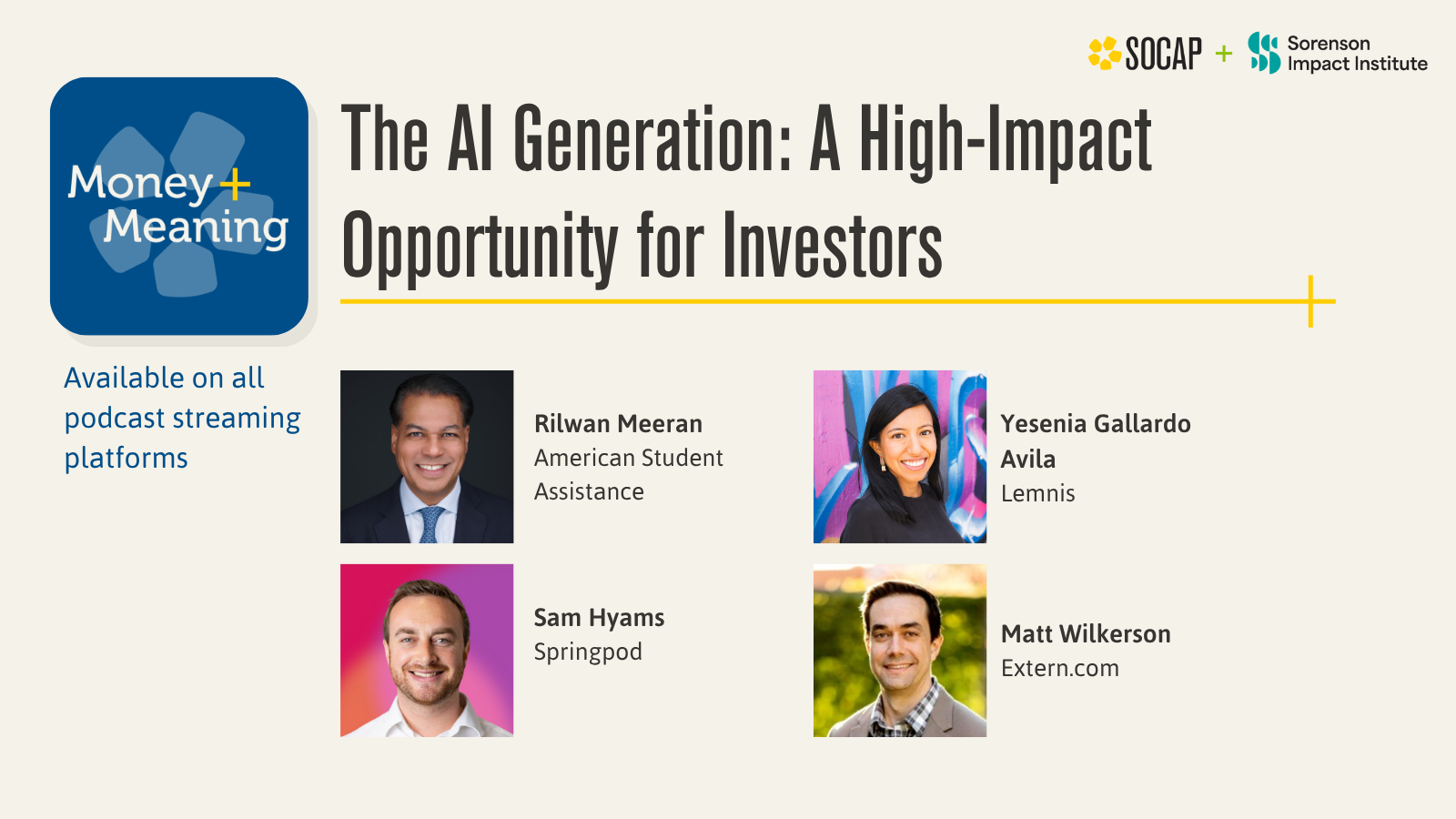

A Money + Meaning Podcast Episode on EdTech, AI, and the Future of Work
AI is transforming the way young people learn, work, and plan their futures. The entry-level job market is shrinking, internships aren’t keeping up, and a generation graduating into an AI-first labor market is trying to navigate shifting expectations in real-time.
In this episode of Money + Meaning, recorded live at SOCAP25 and co-curated with American Student Assistance (ASA), investors and founders working across education, workforce development, and philanthropy explore how capital can help young people thrive because of AI — not in spite of it.
The conversation features:
- Rilwan Meeran, VP of Mission Impact Investing, American Student Assistance (moderator)
- Matt Wilkerson, Founder & CEO, Extern.com
- Sam Hyams, Founder & CEO, Springpod
- Yesenia Gallardo Avila, Managing Director, Alliance Strategy, Lemnis
Closing the Experience Gap in an AI-Driven Job Market
Before diving into solutions, the panelists began by addressing the core challenge facing Gen Z: a growing mismatch between what employers expect and what young people can realistically afford. Experience is becoming the new credential, and it’s harder than ever to get.
Extern.com is tackling what Wilkerson described as a “societal crisis”: Young people simply can’t get enough real work experience to be competitive. “Jobs are shrinking at the entry level,” he said. “You need experience to get work, and internships haven’t scaled to meet the need.”
To help students demonstrate practical AI experience, Extern intentionally embeds AI into the projects it builds with employer partners. “Thirty to fifty percent of each externship is built around using AI — prompting, applying use cases, and working through ambiguity,” he said.
Springpod is addressing similar gaps earlier in the pipeline. “Only 2% of high school students leave school with any hands-on career experience at all,” Hyams said. “Two in three young people leave school with no work experience.” Springpod delivers virtual work experiences built with employers such as Amazon and Airbus, and has supported over a million students globally.
From the investor side, Lemnis is backing early-stage organizations shaping the future of learning and work. “We’re seeing a wide breadth of early innovations,” Avila said, especially tools that help students “map their journeys,” explore interests, and understand their strengths before they choose postsecondary paths.
Skills and Mindsets the AI Generation Needs
The panel agreed: The most important skills aren’t technical — they’re durable. Wilkerson named three foundational capacities:
- learning how to learn (“metacognition”),
- emotional and ethical intelligence, and
- the ability to orchestrate AI systems.
“The skills themselves are going to keep changing,” he said. “You’re going to have to keep up-leveling every 12 to 18 months. What matters is whether you can build, adapt, manage complexity, and show agency.”
Hyams hears a similar refrain from employers. “They say, ‘Don’t worry about the technical skills. We can teach those when they arrive. It’s all about communication.’” Students often struggle to articulate what they’ve learned, which is why Springpod is using AI to “coach them on how to draw out the skills and experiences they already have.”
Avila emphasized flexibility and creativity, backed by stronger science. “We’re investing in the neuroscience of learning,” she said, including cognitive assessments that help students “understand their strengths and design pathways from that place.”

The panel, “The AI Generation: A High-Impact Opportunity for Investors,” at SOCAP25.
Designing AI Tools That Advance Equity
The group emphasized the importance of intentional, equity-centered design. Avila noted that on the philanthropic side, “there are thoughtful conversations happening about responsible AI and equitable tools,” but those same frameworks aren’t yet widely used in venture-backed product development. She called for clearer principles that prevent tools from “perpetuating inequities we’re trying to solve.”
Hyams highlighted the crucial role of student voice in the design process. When Springpod tested its AI-powered interview coach, students immediately raised issues the team hadn’t considered: “They wanted to change or turn off the avatar. They needed subtitles. They needed more control.” That feedback, he said, is essential for accessibility.
Mental health also came up as a foundational equity issue. “You can’t learn optimally if you don’t have your basic needs met and feel a sense of belonging and safety,” Avila said. Lemnis is investing in mental-health–supported learning environments across K-12.
Extern sees the same dynamic. “So much of what we’re doing comes back to mental health,” Wilkerson said, noting how coaching, community, and clear pathways help students overcome both practical barriers and confidence barriers.
Institutions and Employers Are Shifting — Slowly
AI-era workforce preparation will require movement across the entire ecosystem. Hyams sees universities shifting toward applied learning. “There’s a huge move toward integrating work-based learning into curriculum,” he said, including universities where “every course is built around employer challenges.”
At the state and city level, Springpod’s work in Rhode Island shows the power of aligning education and workforce planning: “We work with the workforce board, the governor’s team, and local mayors to identify high-growth industries and talent gaps, and then build experiences with those employers.”
Avila emphasized the overlooked work of implementation in public education. “There’s an implementation piece that’s missing,” she said — not just selling a tool to a district, but ensuring it’s actually used with fidelity, backed by evidence, and supported by teachers and families.
She also highlighted workforce boards as an underused pathway: “I think people underestimate the workforce boards. … They’re convening major employers and shaping the pipeline.”
What Comes Next: Creativity, Pressure, and a Youth-Led Shift
Looking ahead, the panelists expect real volatility — and real possibility. Hyams anticipates AI-native educational products that “create a 10x difference” over existing systems like LMSs or curriculum tools, enough to finally accelerate adoption in slow-moving institutions.
Avila hopes to see deeper collaboration between researchers, evidence-based practitioners, and edtech builders. “We’re seeing more energy around the science of learning,” she said, and more early-stage studios bringing researchers and technologists together.
Wilkerson pointed to a larger generational transition already underway. “There is a very serious revolution happening with young people right now,” he said. Universities can’t respond alone, and many companies are “pulling back” from internships and impact programs even as demand rises. “In the next year, it’s going to get worse,” he warned, which makes coordinated action urgent.
Yet he also sees a creative spark emerging: AI may push young people toward “a new movement toward human connection,” linked to a broader shift away from social media and toward community.
Together, these threads point to a new era of learning and work — one where young people, not institutions, may be the true drivers of change.
Listen to the episode for the full discussion:
Don’t miss out! Subscribe to Money + Meaning on Apple Podcasts, Stitcher, TuneIn, Spotify, or anywhere else you find podcasts.
Listen to more episodes of Money + Meaning here.