
A Money + Meaning Conversation on Making Nature Investable
Nature-based solutions are widely recognized as essential to addressing climate and biodiversity challenges. Yet despite their potential, they remain significantly underfunded. The reasons are familiar: Long timelines, uncertain returns, and limited investor confidence in how to measure and monetize impact.
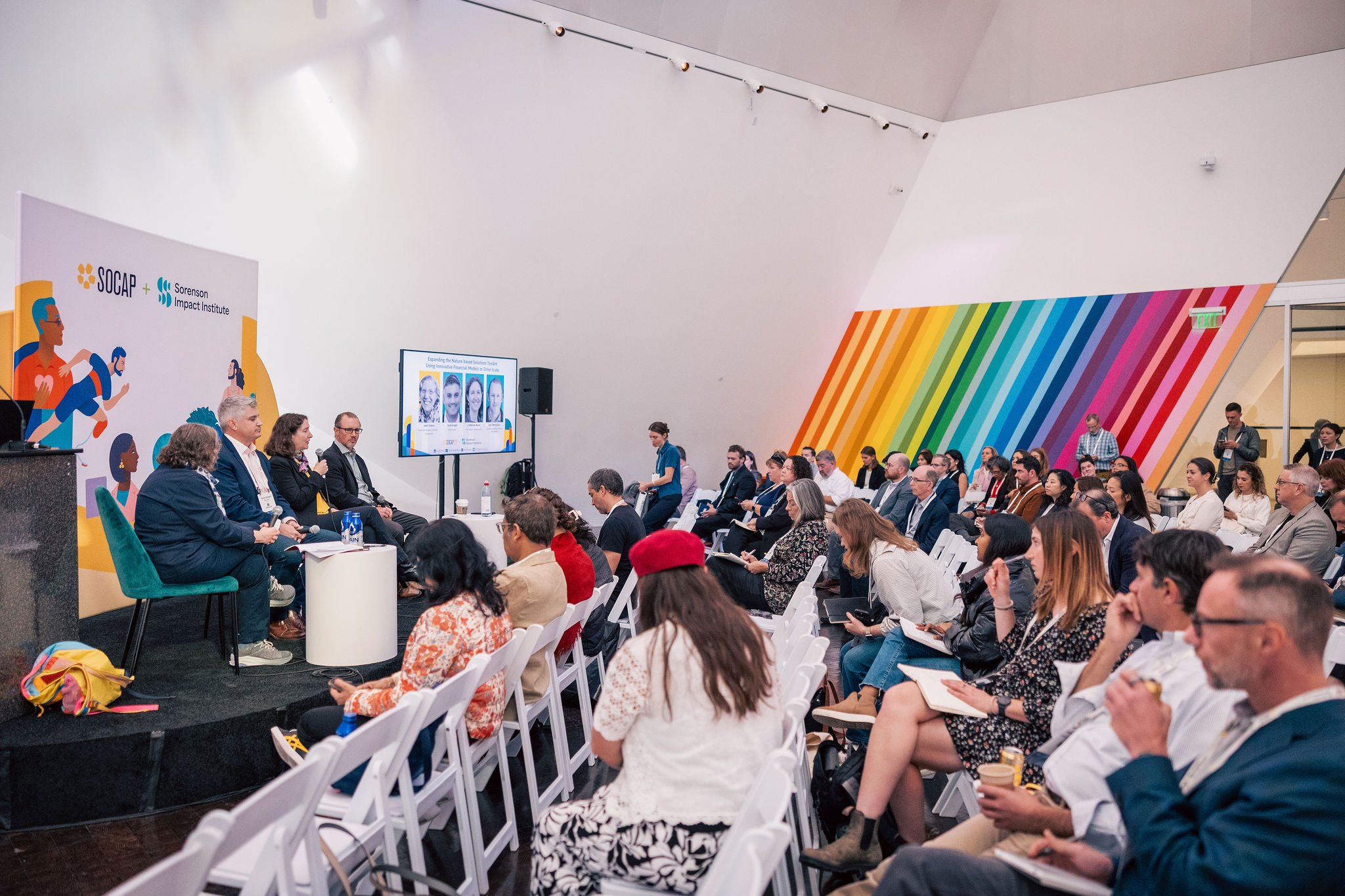
This conversation, recorded live at SOCAP25, explores how new financial approaches are beginning to shift that dynamic. By linking financial returns to measurable results, these structures offer a way to translate long-term environmental value into something investable today.
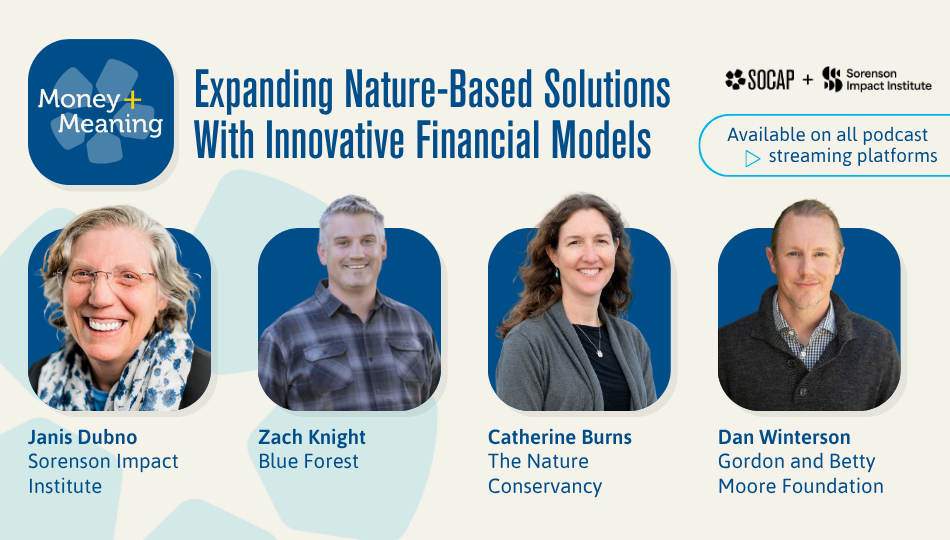
The conversation features:
- Janis Dubno, Managing Director of Impact Finance, Sorenson Impact Institute (moderator)
- Zach Knight, Chief Executive Officer, Blue Forest
- Catherine Burns, Interim Managing Director, NatureVest, The Nature Conservancy
- Dan Winterson, Program Officer, Gordon and Betty Moore Foundation
Bridging the Gap Between Science and Finance
One of the earliest challenges in nature-based finance wasn’t a lack of solutions; it was a lack of alignment. Strong science could point to the long-term value of restoring ecosystems, but many models struggled to answer a more immediate question: Who pays, and how does it work as an investment?
“You need to have the impact… and you also need a business model that’s going to work,” said Winterson. “And those two things seem really obvious, but… we naturally come at that problem from one of those two angles and have trouble seeing the other.”
Over the past decade, that gap has started to close. Practitioners are getting better at designing models where impact and financial logic are built together, supported by advances in measurement that make outcomes easier to quantify and value.
As Knight noted, “We’re building all of that on the scientific innovation that allows us to measure and understand and value these benefits in a way that we couldn’t 10 years ago.” The result is a field that’s maturing — one where credible impact and viable business models are no longer separate challenges, but part of the same design
Making Nature Investable
At its core, outcomes-based financing is simple: Returns are tied, fully or in part, to the delivery of specific outcomes. For nature-based solutions, that shift is powerful. It creates a bridge between long-term ecological value and the shorter time horizons investors typically operate within, translating long-term benefits into signals investors can act on now.
That approach is becoming more viable as measurement improves. Advances in science and modeling are making outcomes easier to quantify — and increasingly, predict.
“You have to be able to measure, quantify, validate the outcomes that are being delivered, because they’re linked to returns,” said Burns. But in this space, measurement isn’t just a supporting tool. It’s foundational.
Dubno noted that the relationship between science and finance is especially tight in nature-based solutions: “In nature-based solutions, the science and the finance are really one in many ways.” That interdependence is what makes these models both promising and complex. The same systems that generate impact also underpin financial performance, meaning the strength of the science shapes what can be financed, and at what scale.
What’s Working and Why
The most effective models clearly align who benefits with who pays. Models work best when those receiving the value are directly tied to funding it.
Second, the field is beginning to move beyond purely bespoke deals toward more repeatable approaches. Early models were often designed from scratch — useful for proving concepts, but difficult to scale. Increasingly, practitioners are building structures that can be adapted and reused over time.
Aggregation and standardization are also helping unlock that shift. By pooling projects and creating more consistent terms, organizations can reduce transaction costs and make opportunities more accessible to institutional capital.
“If I had to fundraise and structure each one of those projects… I would not have launched five projects this year,” said Knight.
At the same time, these models still depend on strong local partnerships and context-specific design, especially in complex ecosystems where community engagement is essential.
What Still Isn’t Working
For all the progress, several challenges continue to hold the field back. One is over-reliance on regulation-dependent models. In some cases, promising approaches have stalled when policy frameworks shift or break down, introducing risks that are difficult for investors to manage.
Another is the tendency to force diverse solutions into a single financial model, particularly carbon markets. While carbon can be a powerful tool, not all nature-based solutions fit neatly into that framework, especially when benefits are highly localized. “We’re trying to make everything fit this one box,” said Knight. “Maybe that’s not the solution.”
There’s also a persistent structural challenge: Many projects still require custom design, which slows deployment and limits scale. Underlying all of this is a deeper tension. Nature-based solutions are inherently local, shaped by specific ecosystems and communities. Finance, by contrast, depends on consistency and scale. Bridging that gap remains one of the field’s central challenges.
The Measurement Challenge
Measurement sits at the center of outcomes-based finance, but it comes with real tradeoffs. Collecting environmental data is complex and expensive, especially when trying to establish baselines and track changes over time. At the same time, investors and decision-makers don’t always need perfect data — they need data that’s reliable enough to act on.
As Knight framed it, different audiences require different levels of precision: “Scientific criteria is here… utility decision-making is here… investor decision-making is down here, in terms of what they need.”
What’s changing is how measurement is done. Advances in remote sensing, satellite data, and modeling are making it possible to track outcomes more efficiently, often at a fraction of the cost of traditional field-based methods.
The shift isn’t away from rigor, but toward relevance: Identifying the indicators that are most predictive and decision-useful, rather than trying to measure everything with maximum precision.
Where the Opportunity Is Now
Looking ahead, the strongest opportunities are emerging in areas where outcomes are easiest to measure and value. Water stands out for its clarity and locality, with benefits tied to specific users. Carbon continues to gain traction as modeling improves and long-term outcomes become more predictable. Forests and wildfire resilience are also gaining attention as the economic and health impacts of inaction become harder to ignore.
“The areas where I think we’re going to see the most growth… are the ones that are most measurable,” said Winterson.
At the same time, some of the biggest opportunities lie in what isn’t yet fully valued. Health outcomes, community benefits, and broader economic impacts are often central to these projects but remain under-monetized.
There’s also growing momentum in the types of capital supporting this work. Voluntary markets are larger and more active than many expected, while blended and structured approaches are helping bridge the gap between philanthropic and commercial investment.

What’s Needed to Move Faster
If there’s one clear bottleneck, it’s not just capital — it’s how early ideas get off the ground. Many investors are willing to fund projects once they’re structured and ready to deploy, but far fewer are set up to support the early-stage work it takes to get there. That leaves a gap for operators developing new models, often without the resources to test, refine, and launch them.
As Winterson noted, that early support can be catalytic: “If we have a good theory of change, and that’s the bottleneck, that’s what we’ll fund… we can invest a relatively small amount to unlock a greater amount.”
There’s also a broader structural challenge: aligning nature’s timelines with capital’s expectations. Many nature-based solutions deliver their full value over decades, while investors are often operating on much shorter horizons. Closing that gap through better financial design, stronger early-stage support, and continued innovation will be key to moving the field from promising models to widespread scale.
Listen to the episode for the full discussion:
Don’t miss out! Subscribe to Money + Meaning on Apple Podcasts, Stitcher, TuneIn, Spotify, or anywhere else you find podcasts.
Listen to more episodes of Money + Meaning here.