
A Money + Meaning Conversation on Cooperatives, Non-Extractive Capital, and Building Power That Lasts
Too often, investors back underrepresented entrepreneurs without supporting the political organizing that protects and expands opportunity. At the same time, donors fund grassroots movements without investing in the long-term economic power that helps communities sustain wins. This conversation, recorded at SOCAP25, makes the case that communities need both — and that economic and political power grow stronger when built together.
This episode of Money + Meaning examines the intersection of economic and political power, why ownership and governance matter, and how capital can support communities in building lasting self-determination.
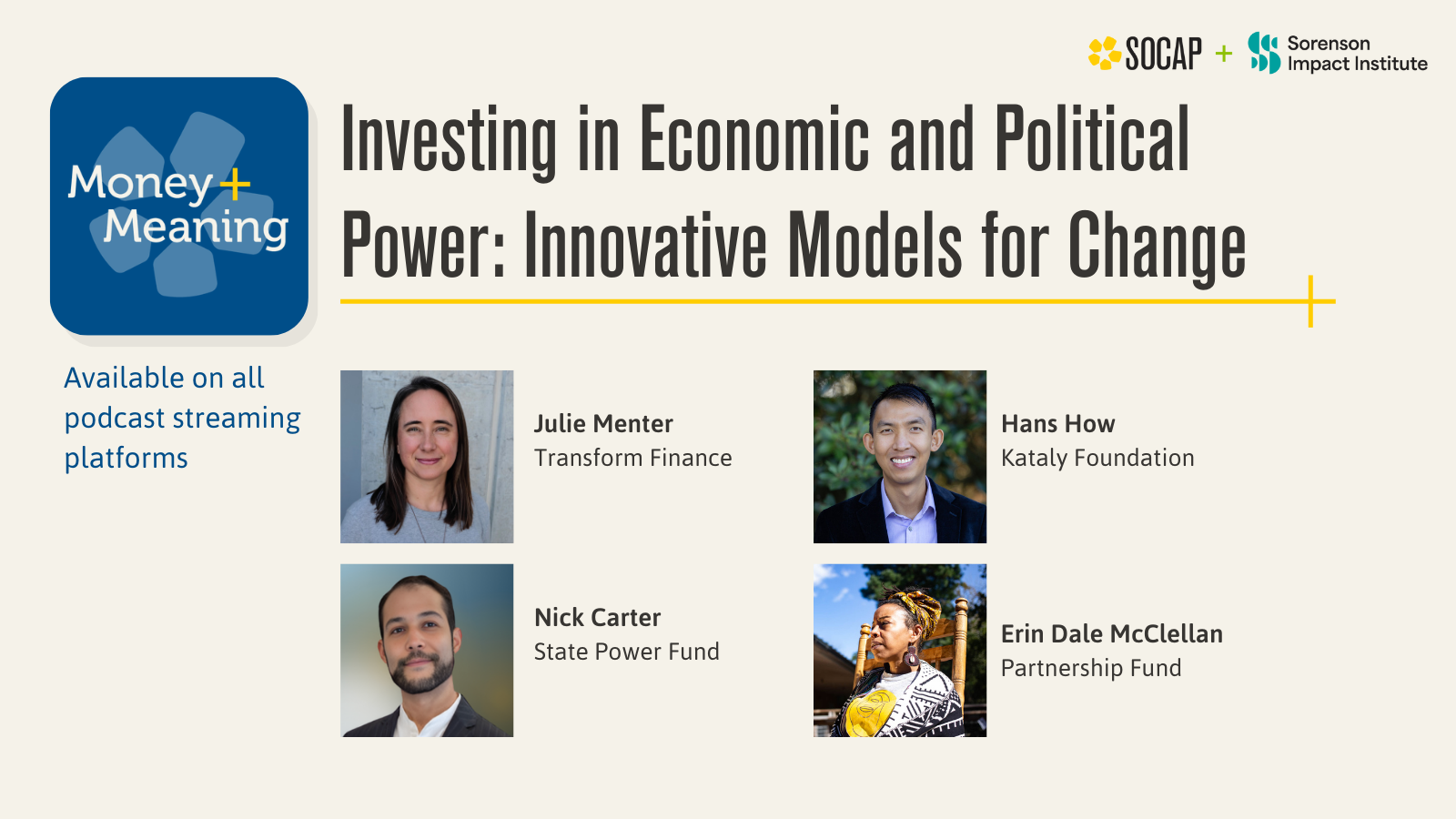
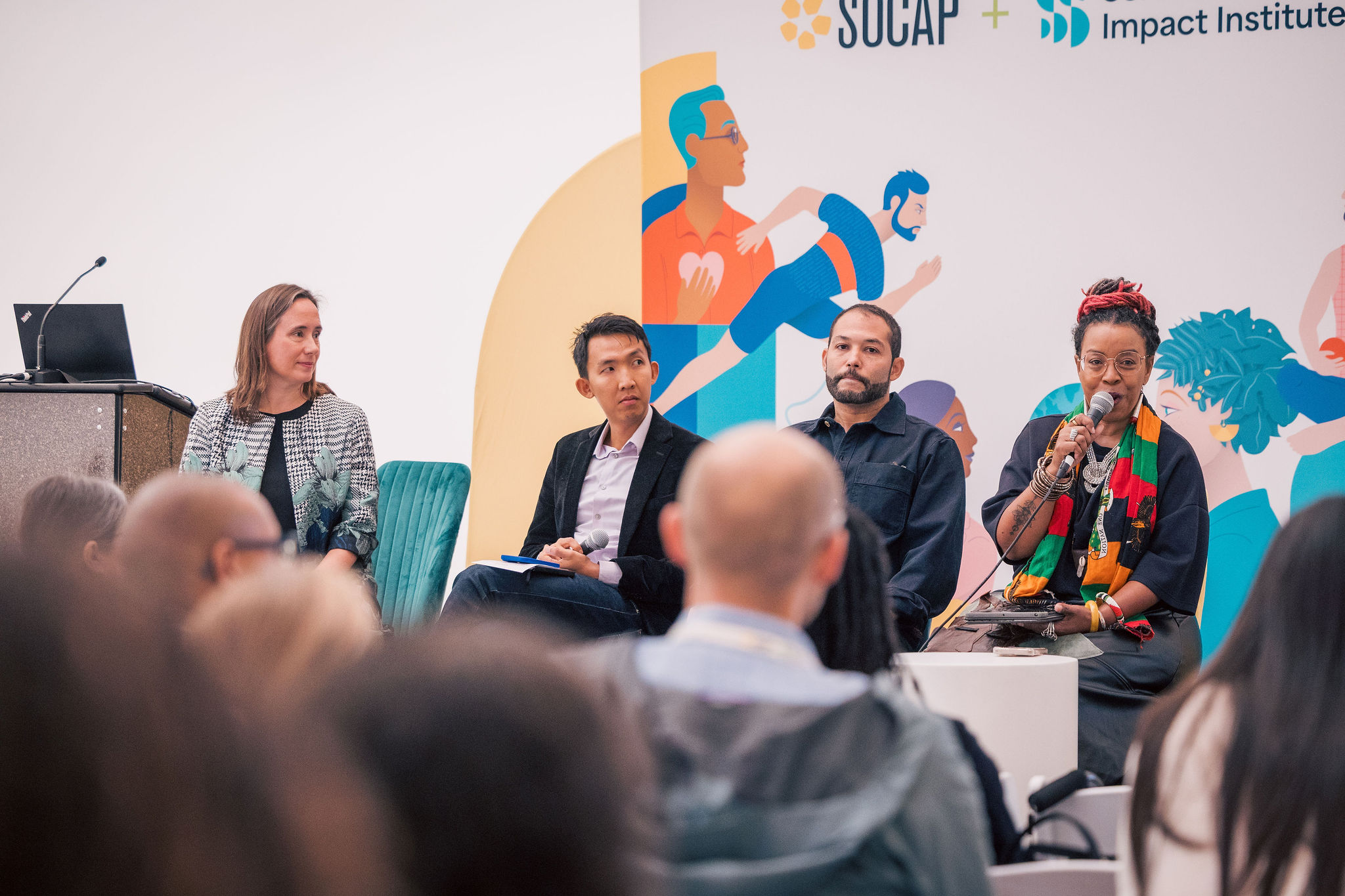
The conversation features:
- Julie Menter, Program Director, Transform Finance (moderator)
- Erin Dale McClellan, Executive Director, Partnership Fund
- Nick Carter, Technology, Capital, and Governance Advancement Fellow, State Power Fund
- Hans How, Integrated Capital Officer, Restorative Economies Fund, Kataly Foundation
What Power Really Means and Why Economic Power Comes First
The panel began by widening the definition of power itself. For Erin Dae McClellan, power isn’t just who sits at the top of a hierarchy — it’s “living energy,” and it’s cyclical: the ability to define reality, set an agenda, implement it, maintain it, and do it again. She emphasized that power is built in community, not by individual heroes, and named forms of power often left out of capital conversations: spiritual power, narrative power, and modeling power, alongside economic and political power.
That broader framing matters because it allows more people to see themselves as power-builders, and it challenges funders to stop treating power as something they grant rather than something communities cultivate.
From there, the panel made a clear case that economic power is a prerequisite for political power. Hans How grounded this in something concrete: ownership and decision-making, not just income. Control over land, labor, infrastructure, and assets determines whether people can meet basic needs and whether they have the capacity to organize politically.
Nick Carter sharpened the point. Treating economic life as “not political,” he argued, is a mistake. Without time, money, or voice, participation in democracy becomes structurally harder. Or, as he put it: You might not be interested in politics, but politics is interested in you. McClellan brought it back to human stakes: When neighbors are hungry or unstable, scarcity breeds desperation, social cohesion frays, and democracy itself becomes more fragile.
Power in Practice: Civic Economies and Cooperative Models
The conversation then turned from theory to practice. Carter shared examples from the State Power Accelerator, which invests in state- and community-based organizations building businesses connected to civic engagement. Democracy work, he noted, is already shaped by market dynamics and private capital, often with little oversight or governance. Building independent political power requires capacity, technical skill, and sustainable financial models, especially as civic engagement becomes more tech-intensive.
While modest relative to the broader political industry, the results are instructive: Accelerator-backed organizations have generated tens of millions in revenue and millions in profit, pushing back on the idea that democracy-aligned investing is simply money into an abyss. Instead, it can be resourced in ways that build durable infrastructure.
McClellan offered a parallel pathway through cooperatives: organizations that allow people to practice democracy in everyday life, not just at the ballot box. She described co-ops as vehicles for belonging, democratic governance, and shared economic futures, while also acknowledging that cooperatives take many forms and aren’t inherently equitable without intentional design.
She highlighted the Collective Courage Fund, inspired by Dr. Jessica Gordon Nembhard’s work on African-American cooperative economic thought and practice, which provides general operating support to Black-led food and land cooperatives. The goal is not only enterprise growth, but stronger membership, deeper governance, and the ability to attract additional capital without being hollowed out by program-restricted funding.
One distinction she offered is particularly striking: There’s a difference between practicing democracy and experiencing democracy.
Moving Capital Without Extracting Power
Hans How grounded the conversation in Kataly Foundation’s approach to non-extractive capital. He shared the example of Seed Commons, a cooperatively governed loan fund supporting worker co-ops with financing and technical assistance designed around a simple principle: a borrower should never be worse off after working with you than before.
That standard becomes a quiet indictment of traditional capital, where terms, timelines, and reporting requirements often extract capacity even when money is framed as support. Throughout the discussion, the panel returned to how funders show up in relationship: Is the engagement transactional? Are grants multi-year and unrestricted? Is capital patient and flexible? Are reporting requirements designed for learning or for control?
This shift shows up not just in structure, but in language. McClellan challenged the term “concessionary returns,” which implies investors are owed something and that anything less is a charitable favor. Instead, she pointed to language like restorative, reparative, or regenerative returns — frames that better reflect capital intended to repair harm, restore relationships, and return control. How echoed this framing, naming non-extractive investment as a baseline rooted in an honest assessment of how wealth has been built through extraction over time.
What Would Accelerate This Work
Across the conversation, several needs surfaced clearly:
- More on-ramps that reduce legal, logistical, and operational barriers to moving capital toward power-building ecosystems
- Bridge-builders who can translate between organizing, finance, and policy worlds
- A different approach to risk, where experimentation is embraced not only in venture markets but also in shared-ownership and community-governed models
- Long-term commitment that replaces panic-driven decision-making with patience and staying power
McClellan closed the loop with a personal reflection on watching her own retirement account swing wildly and wondering what it would mean to build a restorative economy with a steadier posture: less fear, more trust, and a willingness to stay in it for the long haul.
One Takeaway to Carry Forward
- McClellan: Leaders need breath, time, and space — not just money — to innovate and refine strategy in moments that feel constricting.
- Carter: Democracy work can’t be confined to a narrow bucket; education expands what’s possible.
- How: Those with power must ask whether they’re willing to give some up so others can gain it — and to take more risk so communities can take fewer.
Listen to the episode for the full discussion:
<
Don’t miss out! Subscribe to Money + Meaning on Apple Podcasts, Stitcher, TuneIn, Spotify, or anywhere else you find podcasts.
Listen to more episodes of Money + Meaning here.