
A Money + Meaning Conversation on Inclusive Private Credit and Business Ownership
Conversations about business finance often focus on two ends of the spectrum: venture capital for high-growth startups and traditional bank loans for established businesses. Yet many companies fit neither model.
Across the country, thousands of businesses find themselves caught in a financing gap. They have outgrown early-stage sources of capital but remain too small, too community-focused, or too unconventional to attract institutional investors. These businesses often create jobs, strengthen local economies, and build community wealth, but they frequently struggle to access the flexible financing needed to reach their next stage of growth.
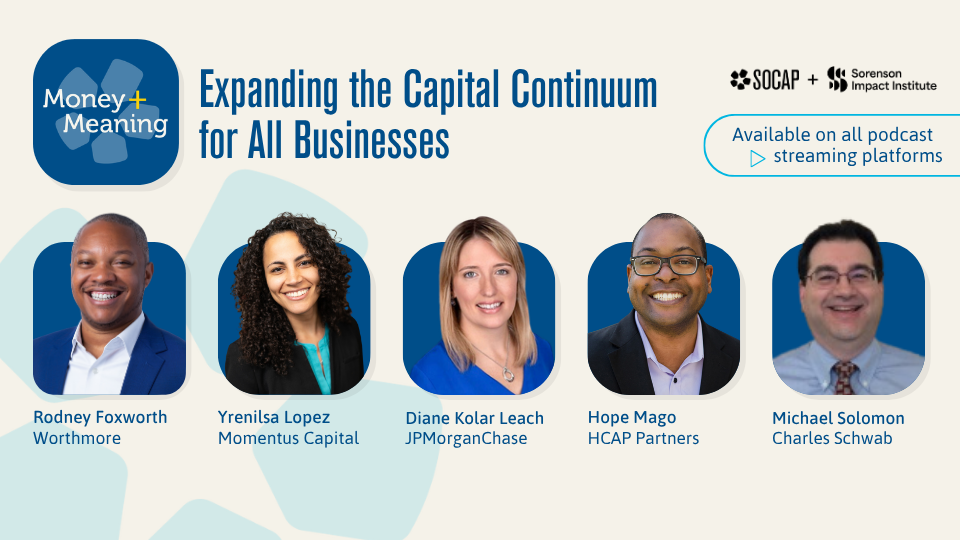
This conversation, recorded live at SOCAP25, explores how investors, fund managers, and financial institutions are working to close that gap. Tune in to hear from:
- Rodney Foxworth, CEO, Worthmore (moderator)
- Diane Kolar Leach, Executive Director, Global Philanthropy, JPMorganChase
- Hope Mago, Managing Director, HCAP Partners
- Yrenilsa Lopez, Managing Director, Momentus Capital
- Michael Solomon, Managing Director, Charles Schwab
Presented in partnership with JPMorganChase and Catalyze, the discussion explores how private credit, acquisition financing, and other flexible capital solutions can help more businesses grow, transition ownership, and create lasting economic opportunity in their communities.
The Businesses Falling Into the ‘Missing Middle’
Much of the conversation centered on a challenge that receives far less attention than venture capital funding rounds or startup accelerators: the thousands of businesses that fall into what panelists described as the “missing middle.”
These businesses have often outgrown early-stage financing options but are not large enough to attract traditional institutional capital. “The problem is that a lot of these businesses aren’t able to access the flexible, timely capital that they need to grow,” said Diane Kolar Leach of JPMorganChase. Yet they frequently serve as important engines of local economic development, creating jobs, building community wealth, and supporting regional economies.
Kolar Leach explained that the challenge is particularly acute for businesses in low- and moderate-income communities. As companies grow beyond startup stages, many find themselves caught between financing systems that were not designed for their needs. “These are the businesses that, as they grow, transform from sources of income and wealth for the entrepreneur and their family to engines of growth and opportunity for employees and local communities,” she said.
Panelists argued that closing this gap requires expanding the range of financing options available to growing businesses and ensuring entrepreneurs can access the right type of capital at the right stage of growth.

Why One Size Doesn’t Fit All
Throughout the discussion, panelists emphasized that capital is not a single product. Different businesses face different challenges at different stages of growth, and no single financing tool can meet every need.
Kolar Leach described what she called the “capital continuum,” a spectrum of financing options that ranges from personal savings and community lending to revenue-based financing, mezzanine debt, private credit, and equity investments.
“Each of these financial products has different levels of risk, flexibility, and support, and they’re designed to meet the needs of entrepreneurs at different stages of their growth journey,” she said.
Hope Mago of HCAP Partners explained that one advantage of private credit is its flexibility. Rather than offering a standardized financing product, private lenders can work with entrepreneurs to understand their goals and structure capital accordingly.
“We don’t work in a plain vanilla box,” Mago said. “We’re going to sit down with an entrepreneur, understand what your business plan is, where you want to take your business, and what type of capital you need to help you execute on that growth story.”
Investors Are Becoming Partners, Not Just Capital Providers
Panelists emphasized that capital alone is rarely enough to help a business reach its next stage of growth. For many private credit providers, the role extends well beyond writing a check.
Investors often work closely with entrepreneurs to provide strategic guidance, operational expertise, and access to experienced leaders who can help navigate growth challenges. “We’re not just looking at ourselves as a capital provider,” said Mago.
Rather than applying a standardized financing model, firms like HCAP seek to build long-term partnerships tailored to each company’s needs. “We look at ourselves as a partner,” said Mago. “We’re not just looking at ourselves as a capital provider, because in our eyes, if you do well, we do well.”
That partnership can include helping entrepreneurs evaluate growth opportunities, enter new markets, strengthen operations, and prepare for future expansion. For many founders, panelists suggested, that support can be just as valuable as the capital itself.
Preserving Businesses and Creating New Owners
One of the most compelling themes to emerge from the conversation was the growing opportunity to preserve existing businesses while expanding pathways to entrepreneurship. Yrenilsa Lopez of Momentus Capital pointed to what many investors have begun calling the “silver tsunami”: a wave of retiring business owners preparing to exit companies they have spent decades building. Across the country, many of these businesses remain healthy and profitable. Yet owners often struggle to find successors, particularly when family members are not interested in taking over operations.
“We have many, many small businesses that are boring but stable, cash-flowing businesses that are almost in danger of dying out because we have retiring owners who have brought up these businesses from their kitchen table,” Lopez said.
At the same time, many aspiring entrepreneurs possess the experience and ambition to run successful businesses but lack the personal wealth, family resources, or investor networks needed to acquire one. To address this gap, Momentus Capital has developed financing strategies focused on entrepreneurship through acquisition (ETA), helping new owners purchase and grow existing businesses that might otherwise disappear. “These businesses go beyond what the SBA products would be able to finance, but are similarly smaller than what an SBIC would be looking at,” Lopez explained. “That’s where we step in.”
Panelists discussed financing structures such as seller rollovers and earn-outs that can help align incentives between buyers and sellers while reducing risk for investors. These approaches can make business ownership more accessible to entrepreneurs who may not have substantial personal capital.
For impact-focused investors, the opportunity extends beyond preserving individual companies. Successful ownership transitions can help retain jobs, maintain local economic activity, and create new pathways for wealth creation in communities that have historically faced barriers to capital and ownership.

Building the Ecosystem Behind the Capital
While much of the discussion focused on entrepreneurs and growing businesses, Michael Solomon of Charles Schwab highlighted a less visible reality: The funds providing capital need investors of their own.
Expanding access to inclusive private credit requires an ecosystem of capital providers willing to support emerging fund managers and innovative financing models. That ecosystem can include banks, foundations, family offices, pension funds, and other institutional investors, each with different goals, risk tolerances, and investment requirements.
Solomon noted that attracting more capital into the sector often requires creating investment structures that align with the needs of different allocators. Some investors may seek traditional equity exposure, while others are looking for lower-risk or more flexible approaches that allow them to participate in impact-oriented investments.
“Different capital allocators want to allocate different types of capital,” added Kolar Leach.
Several speakers pointed to public-private partnerships as an important tool for attracting additional capital into underserved markets and helping emerging fund managers scale their work. “The most successful partnerships are across the spectrum,” Solomon said.
Others emphasized the need for stronger collaboration and greater transparency across the field. Data emerged as another recurring theme. As the market grows, investors increasingly need better information to evaluate opportunities, compare approaches, and understand what is working.
“I think the biggest challenge is data,” said Kolar Leach. “Showing how you have a track record of finding the right businesses, offering them the right type of capital, and helping them grow in a sustainable, healthy way.”
Ultimately, panelists agreed that no single institution can close the capital gap alone. “It’s really important to have an ecosystem that’s working together and fosters innovation,” Kolar Leach said.
Listen to the episode for the full discussion:
Don’t miss out! Subscribe to Money + Meaning on Apple Podcasts, Stitcher, TuneIn, Spotify, YouTube, or anywhere else you find podcasts.
Listen to more episodes of Money + Meaning here.