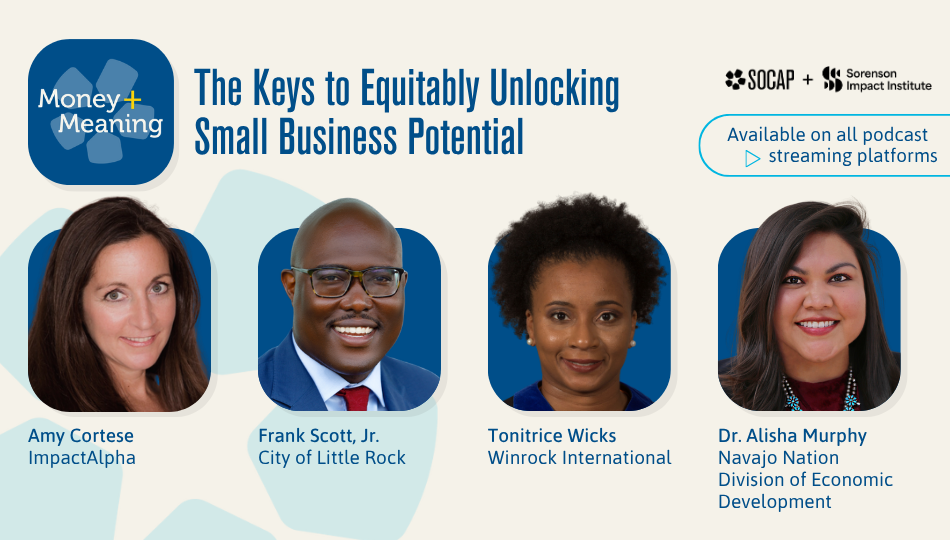

A Money + Meaning Conversation on Building Resilient Local Economies for Socially and Economically Disadvantaged Entrepreneurs
Small business finance is often discussed as a single, static problem: Entrepreneurs need capital, and capital isn’t reaching them. But access looks entirely different depending on where a business sits and who governs the ground beneath it. A rural town in the Mississippi Delta, a mid-sized Southern city, and a sovereign tribal nation each face their own version of the same challenge, shaped by different histories, different systems, and, increasingly, different levels of federal disruption.
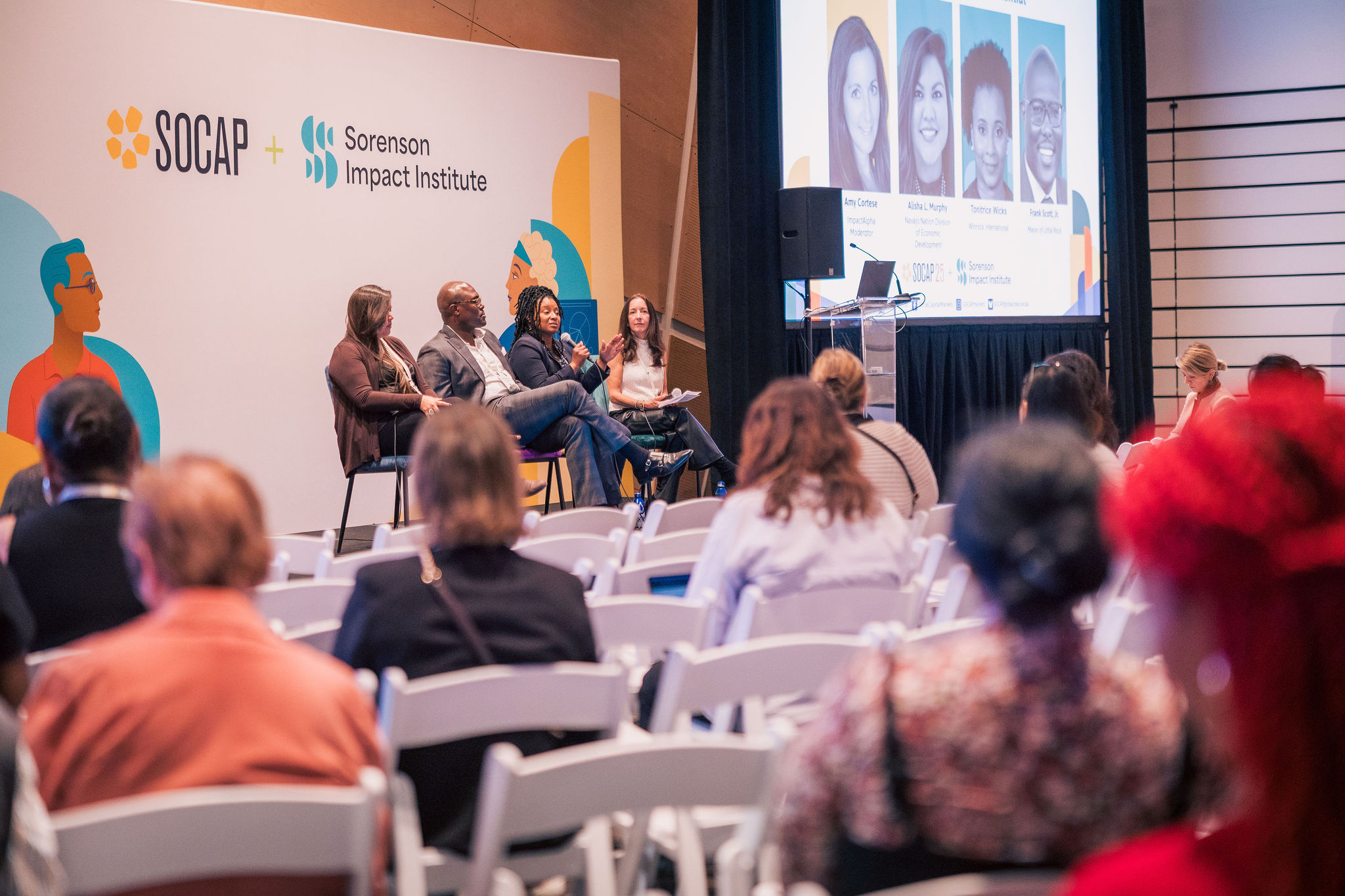
This conversation, recorded live at SOCAP25 and moderated by Amy Cortese, Editorial Director at ImpactAlpha, brings together these three vantage points to explore how targeted business support and cross-sector collaboration can help reduce marginalization and build more resilient local economies for socially and economically disadvantaged entrepreneurs.
Though all three panelists share a common goal, they work within very different systems, each with its own version of the access-to-capital problem.
- Tonitrice Wicks, a senior program officer at Winrock International, focuses on small businesses across the rural Southeast, particularly the Mississippi Delta, often working with entrepreneurs who don’t yet see themselves as business owners. “My goal is to help businesses realize that what they have isn’t just an expensive hobby, it’s a real business,” Wicks said.
- Frank Scott Jr., Mayor of the City of Little Rock, brings a city-government lens shaped by his background as a banker, with a focus on historically overlooked, majority Black and Brown areas of Little Rock. “We have to make certain individuals are bankable, so they can get the bank dollars to scale up,” he said.
- Dr. Alisha Murphy, an economist with the Navajo Nation Division of Economic Development, works within the added complexity of tribal sovereignty and trust land, where banking is largely unavailable, and many entrepreneurs operate informally. “Access to capital has always been a concern, and it’s not because of systems, it is because of systems that are not built for tribal communities,” Murphy said.
When Federal Support Disappears, It Hits Fast
The clearest theme of the conversation was how quickly federal disruption becomes real harm on the ground. For Murphy, the Navajo Nation’s business site leasing process runs through the Bureau of Indian Affairs, meetings that stopped entirely during the federal shutdown. “That is an immediate and critical issue that stops business growth and development, quite literally,” she said.
For Wicks, it arrived as a phone call: a grocery store owner in a rural, low-income area, whose store draws 60% of its revenue from SNAP, panicking over looming benefit cuts. “She said, ‘What am I going to do?’ And I was honest. I said, I don’t know, but we’ll figure it out,” Wicks recalled.
Scott described a parallel strain in Little Rock’s schools, where free and reduced lunch staff who rely on SNAP themselves may be forced to leave their jobs if benefits lapse, potentially leaving the district short-staffed to serve meals. As Wicks put it, “The past solutions are not working in this current climate.”
Redefining ‘Bankable’
For Mayor Scott, closing the capital gap in Little Rock has meant rethinking who has access to the city’s own procurement dollars and building the infrastructure to bring more entrepreneurs into the city.
When Scott took office, minority-owned business spend in the city sat around 8%, despite Little Rock being a majority-global-majority city. To address the gap, the city launched a joint venture policy encouraging large contractors to partner with minority- and women-owned businesses, along with a business leadership cohort that helps entrepreneurs learn to manage and scale their businesses and enter the city’s procurement pipeline. Minority spend has since climbed to roughly 20-25%.
A recent disparity study gave the city further grounds to act, but, given legal and political constraints on race-based programs, Little Rock structured its small-business certification program around revenue rather than race or gender: businesses with revenue between $500,000 and $3 million can qualify for set-asides.
Public-Private-Philanthropic Partnerships (“P4”)
Scott described much of Little Rock’s recent progress through what he calls “P4”: public-private-philanthropic partnerships. By combining city dollars with contributions from local banks, foundations, and philanthropies, including Hope Credit Union, Southern Bancorp, First Security, the Winthrop Rockefeller Foundation, and Bloomberg Philanthropies, the city has been able to advance initiatives like its affordable housing trust fund, work Scott sees as directly tied to business growth, since access to capital and working capital often go hand in hand. “I think if you want to get something done, you’ve got to get it done with the city,” he said.
Wicks described a similar dynamic in her work with Winrock, though at a different scale: Her funders, including Walmart and the Visa Foundation, function less like traditional grantmakers and more like partners willing to adjust course as conditions change. Rather than being locked into a fixed proposal, Wicks said she can go back to funders when circumstances shift on the ground and revise the plan together. “We’ve been allowed the flexibility to talk to them and say, this is what’s happening in the community, can we do this?” she said.
The Grassroots Connectors
Both Wicks and Murphy pointed to the same underlying pattern: Closing the capital gap often depends less on funders or government agencies themselves, and more on trusted local intermediaries who already have relationships on the ground.
In the Mississippi Delta, Wicks described working with a retired small business development center director she calls Mr. Finley, who had kept the center running largely on volunteered time after it lost its funding years earlier. With support from Winrock’s funders, Wicks was able to help build his capacity, coaching him through grant reporting and proposal writing so he could better capture and communicate the technical assistance work he was already doing informally, from walking business owners through QuickBooks to helping them see themselves as legitimate business owners in the first place.
For Murphy, that same role is played by Change Labs, a nonprofit that has spent nearly a decade building relationships with Navajo entrepreneurs. When the Navajo Nation launched its State Small Business Credit Initiative program, Murphy said Change Labs was essential to translating between federal and tribal requirements and the realities of home-based, multigenerational businesses. “They know our businesses,” Murphy said.
Meeting Entrepreneurs Where They Actually Are
An audience question about technical assistance models, one-on-one coaching versus scalable classroom training, drew out real differences in how each panelist’s community is served. Scott said Little Rock leans toward classroom-style training, aiming to reach as many entrepreneurs as possible at once, trusting that the most motivated business owners will separate themselves from the group. Wicks described a blended approach at Winrock: structured trainings alongside one-on-one coaching, which she said entrepreneurs consistently say they value most, since it meets them exactly where they are, whether that means walking someone through opening a bank account or supporting them through a moment of financial panic.
Murphy noted that the Navajo Nation’s nonprofit partners often provide more flexible, after-hours, and virtual technical assistance than tribal government offices can offer on a standard workday schedule, a meaningful distinction for entrepreneurs who run businesses alongside full-time jobs. She added a cultural dimension: many Navajo entrepreneurs, often multigenerational, home-based businesses, don’t always identify as business owners at all, which shapes how support needs to be framed and delivered.
Listen to the episode for the full discussion:
Don’t miss out! Subscribe to Money + Meaning on Apple Podcasts, Stitcher, TuneIn, Spotify, YouTube, or anywhere else you find podcasts.
Listen to more episodes of Money + Meaning here.