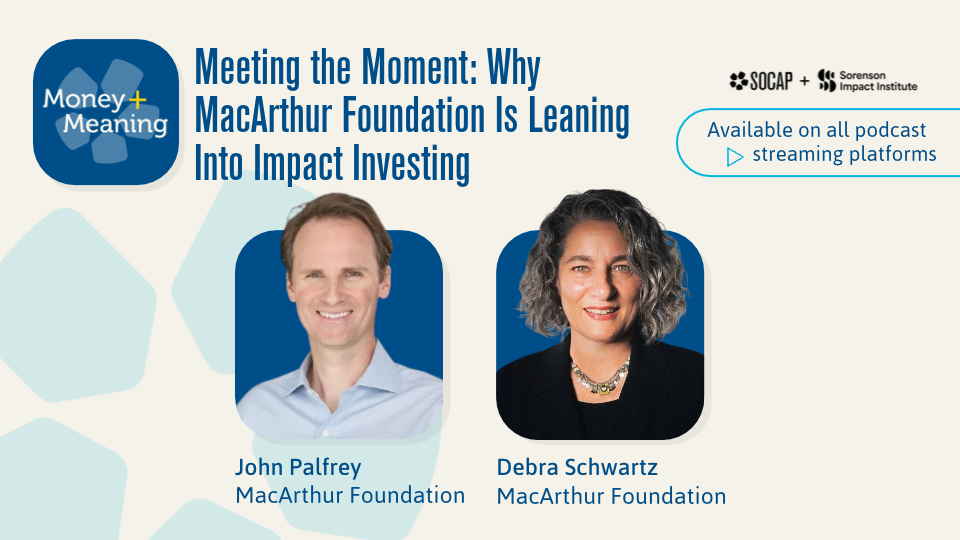

A Money + Meaning Conversation on Strategically Using the Full Spectrum of Capital to Fill Gaps and Align Investments with Mission and Impact
“I think the impact investing field is better than ever…. I actually think this is the time to lean into it more. That’s why we’re putting lots more money into it. And even if that feels against the grain, that makes me want to do it more, not less.” — John Palfrey, President, John D. and Catherine T. MacArthur Foundation
In early October, the MacArthur Foundation announced a dramatic 50% increase in its impact investment allocation, from $500 million to $750 million. At a time when many organizations have pulled back due to political or financial pressures, the MacArthur Foundation is doing the opposite and leaning in.
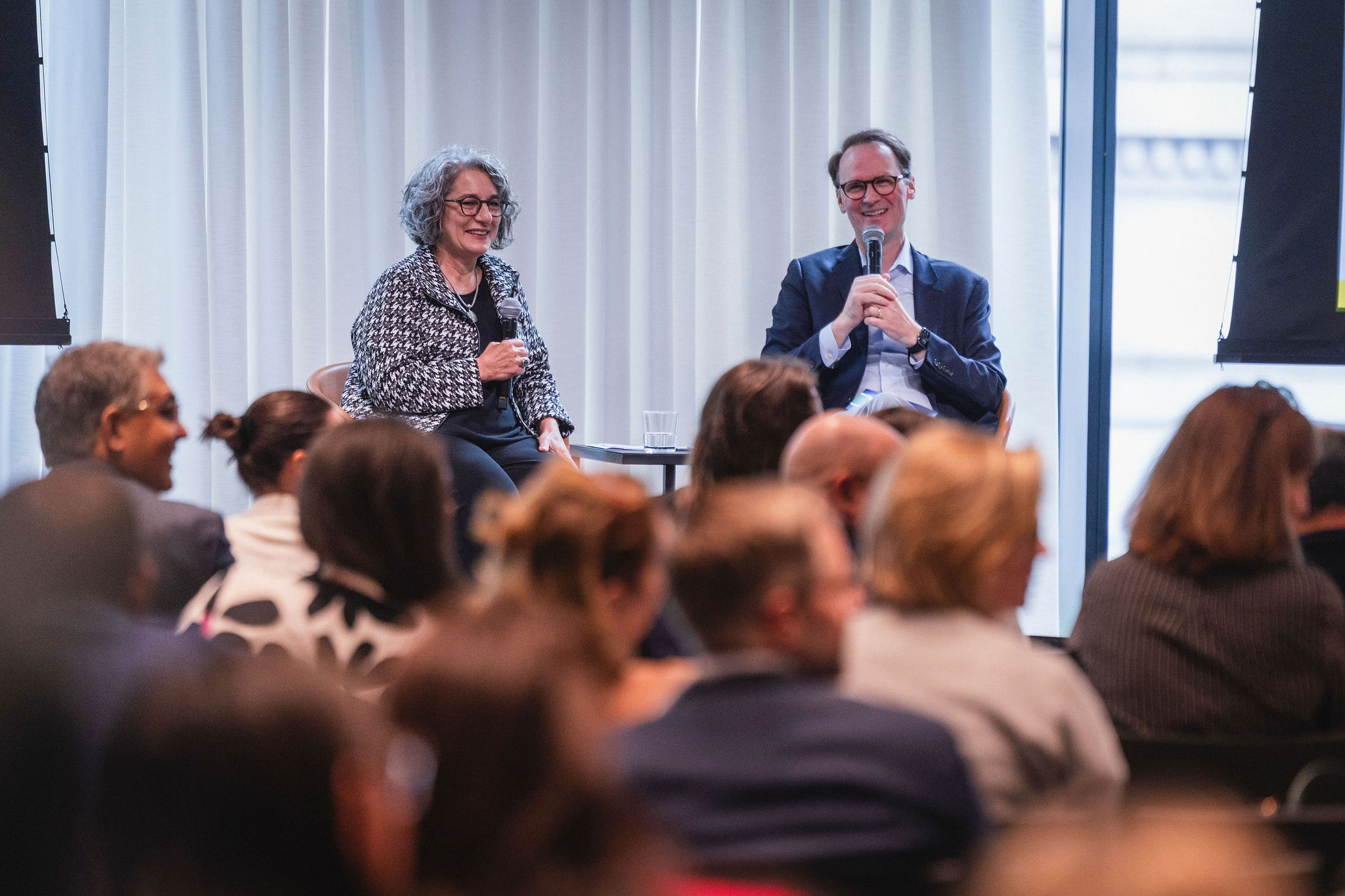
This conversation was recorded live at SOCAP26 in Chicago, MacArthur’s hometown. In it, the foundation’s president and its impact investing lead discuss why MacArthur is leaning in, and how it puts the full spectrum of its capital to work toward “a more just, verdant, and peaceful world.”
- John Palfrey, President of the MacArthur Foundation, came to impact investing by a winding path. He started out at the U.S. Environmental Protection Agency during the Clinton administration and advised the venture firm Highland Capital Partners while he was a Harvard law professor. Since joining MacArthur in 2019, he has become one of the impact investing field’s most vocal advocates. “I just think it’s more important than ever,” he said.
- Debra Schwartz, Managing Director for Impact Investments, has led MacArthur’s impact investing work for many years. That includes embedding investment staff within the foundation’s program teams and co-launching the Catalytic Capital Consortium. Reflecting on MacArthur’s track record, she said, “The reality of 40-plus years is that we can do it.”
A Spectrum of Capital
Palfrey thinks about MacArthur’s capital as a spectrum. At one end are grants, the simplest form of capital. The MacArthur Fellowship is the classic example: $800,000 over five years, with no strings attached. At the other end is the foundation’s endowment of more than $9 billion. MacArthur invests it “returns first, so that we can pay for the grants,” Palfrey said, while increasingly aligning it with the foundation’s mission, including through a growing portfolio of sustainable investments.
Impact investments fill “a very large swath of things that we do in the middle,” Palfrey said. Their purpose is to put capital “in the hands of those who need it,” usually as program-related or mission-related investments, and sometimes alongside a grant. The pool revolves, so as investments are repaid, MacArthur puts that capital back out the door.
Give More, Ask Less
Palfrey didn’t soften his read on the current moment. “We are in a crisis, a full-blown crisis, in basically field after field after field that we work on,” he said. He pointed to attacks on climate work and Native self-determination, the loss of all federal funding for public media, and cuts to USAID, whose full effects are only now being felt. His conclusion was simple: “It is our job to do more and ask less of others.”
“It is our job to do more and ask less of others.” — John Palfrey
That conviction has changed how much MacArthur spends. The foundation’s charter requires it to exist in perpetuity, so spending everything down isn’t an option. But perpetuity doesn’t lock it into the 5% minimum payout either, especially since the endowment’s real returns have exceeded that. “Does it mean we have to stick to 5%? Of course, it doesn’t,” Palfrey said. In February 2025, the board raised the payout floor to 6% by email, approving it within an hour. MacArthur ended up spending 7%, and it has since extended its “Set it at Six” commitment through 2028.
Asking less also applies to grantees and investees. Palfrey credited MacArthur’s grants management, legal, and finance staff for working out how the foundation can shoulder more of the administrative burden itself, so its partners can focus on their work. “If the net effect is greater impact, that’s the answer,” he said.
Embedded, Not Parallel
At MacArthur, impact investing isn’t a side operation. “It’s not just parallel play,” Schwartz said. Members of her team sit at the table with program staff. John Balbach has worked alongside the climate team for 10 years, and Allison Clark has worked with the Chicago Commitment team for more than a decade. Their job is to bring a market perspective and to co-create investments that directly advance each program’s theory of change.
“Impact investments don’t have to be big to be powerful. They have to be strategic and fill gaps.” — Debra Schwartz
The Arts and Culture Loan Fund shows what that looks like. Clark helped create it with MacArthur’s Chicago grantmakers, and it works with a bank and IFF, a CDFI, to give Chicago arts organizations lines of credit they couldn’t otherwise get. After 17 years, Palfrey said, it has had about one default. “Impact investments don’t have to be big to be powerful,” Schwartz said. “They have to be strategic and fill gaps.”
Palfrey sees the same model working for local news. Through Press Forward, MacArthur and more than 130 other funders are working to rebuild local journalism at a time when the U.S. is “losing two and a half newspapers a week.” Grants are only part of the effort. A struggling newsroom might need working capital to get through a hard stretch, and a growing one might want to buy cash-flowing rural papers and share infrastructure. MacArthur is now working out how to provide that capital with partners.
The approach extends to MacArthur’s newest program, Native Self-Determination, through investments like Raven Indigenous Capital Partners. When asked which programs wouldn’t benefit from impact investing, Palfrey said, “I’m not sure anything is left standing.”
From Tennis to Basketball
Palfrey said big philanthropy used to work like tennis. “You hit the serve, or you didn’t, and it’s your fault or your success,” he said. Foundations had big egos and their own strategies, and they won or lost mostly alone. “But I think we are in an era of basketball,” he said, “at least five on the court.”
The scale of the problems demands it. On climate, AI, local news, and democracy, he asked, “Is there any $10 billion organization that could solve that? Absolutely 0% chance.”
Turning the tables, Palfrey asked Schwartz to reflect on the Catalytic Capital Consortium (C3), which MacArthur co-launched in 2019, when the field dismissed anything below market rate as “dumb money.” C3 set out to give patient, flexible, risk-tolerant capital “a name and a frame.”
MacArthur planned for C3 to end, but its partners pushed back and asked to keep going. Today it includes 12 funders, communities of practice, and a library of research and toolkits.
Does It Pay Back?
One audience question went straight to the money: Does MacArthur’s impact investment portfolio return enough to sustain itself? “I think yes is the simple answer,” Palfrey said. The returns don’t match those of a top venture firm, “but that’s not the point.” What matters is that the money comes back, goes out again, and does good in between. Schwartz explained that capital preservation at the portfolio level, over the long term, is now MacArthur’s formal objective. Losses happen, but interest and earnings more than cover them. Palfrey welcomes some risk: “It’s fine to default, by the way. We ought to be taking risk.We have things that fail, and there are spectacular successes.”
That track record is also how Palfrey answered a question Schwartz gets often: How did MacArthur get its board to approve the increase? The groundwork took time, he said, but once the modeling was done, the decision was like picking an apple at just the right moment in the fall. “With the sense that we have a crack team that knows what they’re doing, this was not a hard decision at all.”
The Ampersand
The impact field has long framed its work as a trade-off: investment or grant, returns or impact. Palfrey doesn’t accept that. “On the keyboard, my favorite sign is that ampersand,” he said. “There’s no reason to see this as a negative kind of trade-off.”
He pointed to the SOCAP26 immersive sessions that took place around Chicago, including Erika Allen’s work turning food waste into energy and compost with a long-disinvested community, and mHUB. “These are ones that needed a particular set of capital, and we have it,” he said. “I think we are leaving impact on the table if we don’t do more in this space. From a fiduciary perspective, I think it is bordering on malpractice not to do this.”
Listen to the episode for the full discussion:
Don’t miss out! Subscribe to Money + Meaning on Apple Podcasts, Stitcher, TuneIn, Spotify, YouTube, or anywhere else you find podcasts.
Listen to more episodes of Money + Meaning here.
Photo by Hardwig Media.