
Honoring Her Enduring and People-Centered Career
If you’ve ever sent an email to SOCAP, sought customer support about the event, volunteered at a SOCAP, or checked in at the live event’s registration desk anytime in the last 15 years, you have likely had a very open and lovely conversation with Fabienne Blanc. Fabienne has led the registration process (and so much more) at SOCAP since SOCAP11, when she jumped in, ready to lend a hand when Rosa Lee Harden, a SOCAP co-founder, asked for her help.

At that time, fewer than 1,000 people registered for SOCAP. As the event has grown to more than 2,000 attendees, spent years in multiple locations in San Francisco, changed ownership and staff, and even went virtual-only during the COVID pandemic, Fabienne has played a key role in keeping the event true to its mission while growing and evolving through the years.
In her words: “People come to think deeply… about why they are doing things, what the big ideas are, how one idea applies to other fields, and what the consequences are. There’s the money, and there’s the meaning of money. Why are we doing this?”
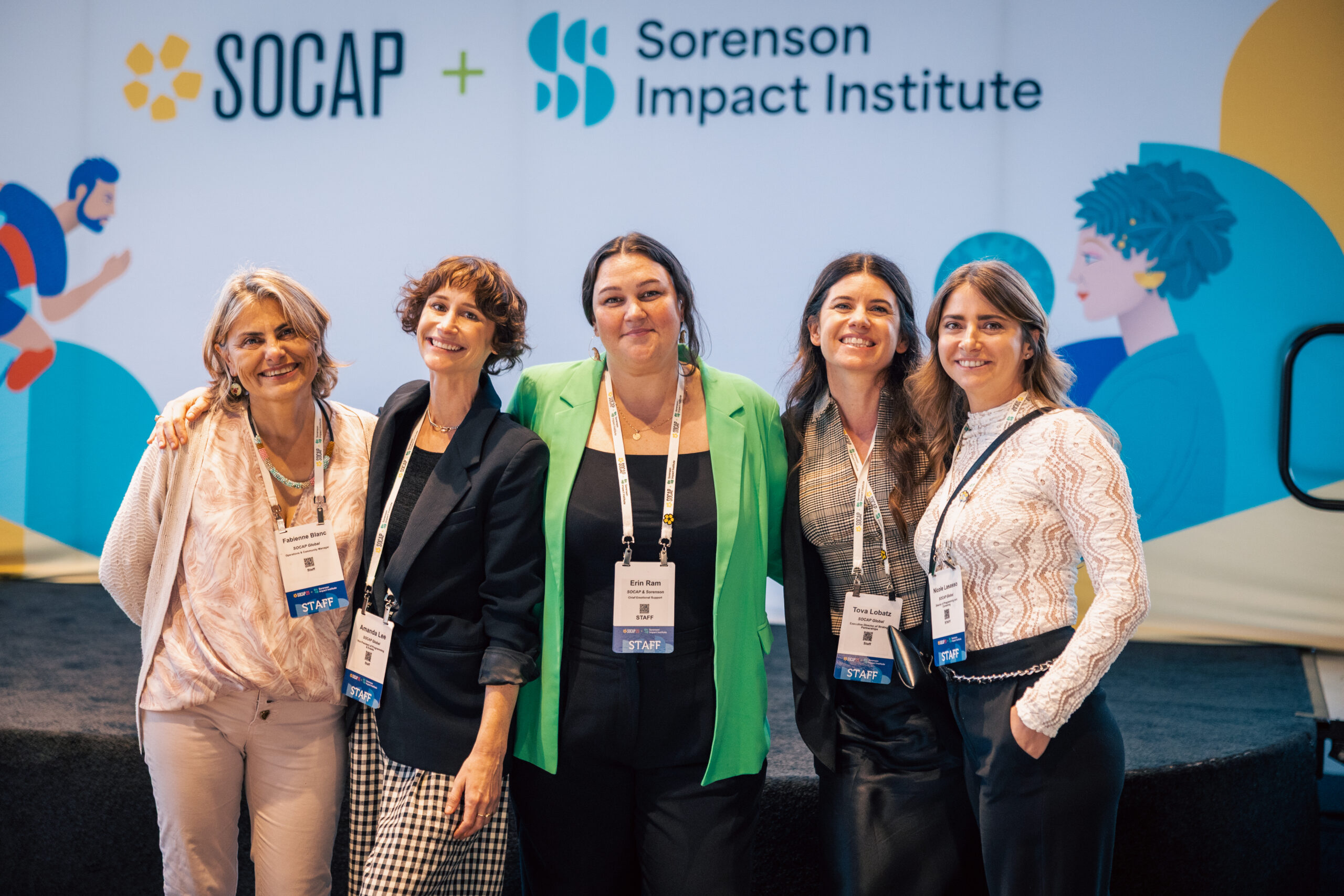
As we prepare for SOCAP26, Fabienne is preparing for the next stage in her life: retirement, travel, and a relocation back to her home country, France, with her husband. Fabienne is, as many of the SOCAP team members put it, “the heart of the SOCAP community,” and we wanted to take a moment to honor her legacy and role in making SOCAP the powerful, impactful, and authentic community that it is today.
“If SOCAP has kept our focus on caring deeply about people and wanting to change the lives of people for the better all over the world, it’s at least in part because Fabienne has kept us centered on that,” says Robert Munson, President and CEO of SOCAP Global. “She cares deeply about everyone around her. She cares deeply about people she’s never met, and she cares deeply about everyone across the planet.”
Below, Fabienne answers a few questions to provide her perspective on how SOCAP has changed over the last 15 years alongside the field of impact, what has kept her dedicated to the event year after year, and what she hopes for SOCAP’s future.
Why were you initially drawn to be a part of SOCAP? What has kept you involved this long?
Rev. Rosa Lee Harden (SOCAP co-founder) had the SOCAP Europe conference planned for Amsterdam in 2011. Her partners in Amsterdam wanted a European to do registration, and she wanted somebody in San Francisco to do registration. I was a parishioner in her church, and I am French, so she called me, and she said, “Can you do registration?”
I had quit my job about six months earlier. This offer landed on my lap, and that was perfect because I could do it from home with my two kids, who were little at the time.
When the person who typically handled registration for SOCAP in San Francisco didn’t want to renew, she said, “Do you want to stay on?” So I did.
“Fabienne embodies what SOCAP was built for. Fabienne is the SOCAP community.” — Nicole Lasasso, SOCAP Executive Director of Programming & Convening
I handled registration in-person for the first time at SOCAP11 at Fort Mason. Registration was in the Festival Pavilion, and I didn’t have internet, so I sort of did the on-site registration for that one from memory. We had been working to print attendee badges, and we had reread that list so often, that I almost knew them by heart. There were not that many people, maybe 800. It was small, but it was fun. Everybody was super nice during that first conference. I had a colleague who would come on a regular basis, saying, “Are you okay, Fabienne?” I had the time of my life. I enjoyed that first conference so much.
After the conference, they said, “Every person who has done registration before has cried, and you didn’t cry.” So, that’s how I got the job on a permanent basis. In all my years at SOCAP, I have only cried once.
“I’ve done a lot of events, and registration people usually melt down at some point during the event. Fabienne has never cried at the registration table, which is her claim to fame. And after her first SOCAP, she never left.” — Rev. Rosa Lee Harden (Money + Meaning podcast episode)
While I didn’t go in person to Amsterdam, I did go to the next European SOCAP, in May 2012, in Malmö, Sweden. Because of the age of my kids, that felt like a paid vacation, to travel and do registration in person in Sweden.
There were years we had to house people in Marin County, organize shuttles, and sell hotel rooms. I told Rosa Lee that if I had to organize one more shuttle, I was quitting. I won’t cry, but I will quit!
“Fabienne has been a cornerstone for the SOCAP community for so long, and as part of our team, has truly held together so many different pieces.” – Amanda Lee, Vice President of Programming & Events
I describe SOCAP as putting on a wedding every year, except you also have to provide entertainment, and the entertainment isn’t just the food and the band. You have to provide intellectual stimulation.
Every year, there have been at least some new faces on the team. Every year, there was a new problem to solve. I never got bored. It was almost always fun.
“It’s hard to fully encapsulate what Fabienne means to all of us. She has been such a huge part of my experience at SOCAP from the beginning, and she is also a huge part of the heart of the SOCAP community.” — Tova Lobatz, COO & Executive Director of Strategic Partnerships
What milestones stand out from the last 14 or 15 years?
The first time we went over 1,000 registrants, and when we went over 2,000, it was amazing how much it had grown. We went to 2,000 in 2014 or 2015. It was huge with so many, maybe too many, sessions. It was crazy, but it was fun.
I remember the first time I got to a session, which was nice, because it meant registration didn’t need me.
“Fabienne IS the SOCAP community. She is constantly helping, constantly stepping in, and not making anyone feel bad for needing that level of support.” — Erin Ram, Communications Manager at the Sorenson Impact Institute
There was also the shift to the time when we started to have a lot of sponsors and a lot of people come from traditional institutions, not just the people we had seen before and not specialized groups. That’s when I realized that impact investing was becoming a thing. It wasn’t us trying to do something. Other people in the public at large were thinking about it.
What do you think makes the event special?
I think it’s the people. When we returned in 2022 after being virtual during the pandemic, it was amazing to see people falling into each other’s arms and watch all the friendships that were rekindled. People come to SOCAP to see their friends.
“She is a foundational force of nature and such a bright light to every interaction, both with the team as well as with our community members.” Sarah Sterling, Vice President of Content & Convening
It’s the connections people make. People come to SOCAP to think deeply. For a lot of people, it’s valuable to be in a group of very intellectual and mindful people. You think about why we are doing things, what the big ideas are, how one idea applies to other fields, and what the consequences are.
There’s the money, and there’s the meaning of money. Why are we doing this? Is it just a job, or is it a little more?
Do you have favorite behind-the-scenes memories?
I enjoy seeing people grow, from volunteering in their first year to possibly seven years later, when they’re employed and suggesting sessions through SOCAP Open. In the first few years, I had a volunteer who was super good at connecting with people. It was fun to see her come back recently as employed and attending SOCAP for her work. And there’s a volunteer who’s been there longer than I have!
“Her willingness to cover all the fine details and learn new programs and methods to fulfill her role has given SOCAP such a solid foundation to always be the best it can be.” Casey Terrazas, Director of Production
There were disasters, too. Once the kitchen flooded! In Malmö, Rosa Lee had bought some heavy hardware she wanted back in the U.S. Two colleagues and I tried to ship it. We couldn’t, and we had to ship it to Britain in the end to be brought back to the U.S. After that, we were exhausted, and we went out for drinks. I still have a picture of that cocktail we had in Sweden.
As SOCAP evolves, what do you hope for its future?
In my family, I’m the first generation to attend college. I come from a very blue-collar town in France, so I know it’s not easy to break into an industry. It cannot come from above. It needs to come from inside.
We shouldn’t forget who we are trying to serve. Money is a barrier, but we can’t put on the event for any cheaper and continue to exist. If I win the lottery, I know what I’d do: I’d create more scholarships for more people to attend SOCAP.