
A Money + Meaning Conversation on How Public-Private Partnerships Are Helping Mission-Driven Banks Expand Access to Capital
Public-private partnerships are often discussed in abstract terms, but for mission-driven financial institutions working in underserved communities, they can fundamentally change what’s possible.
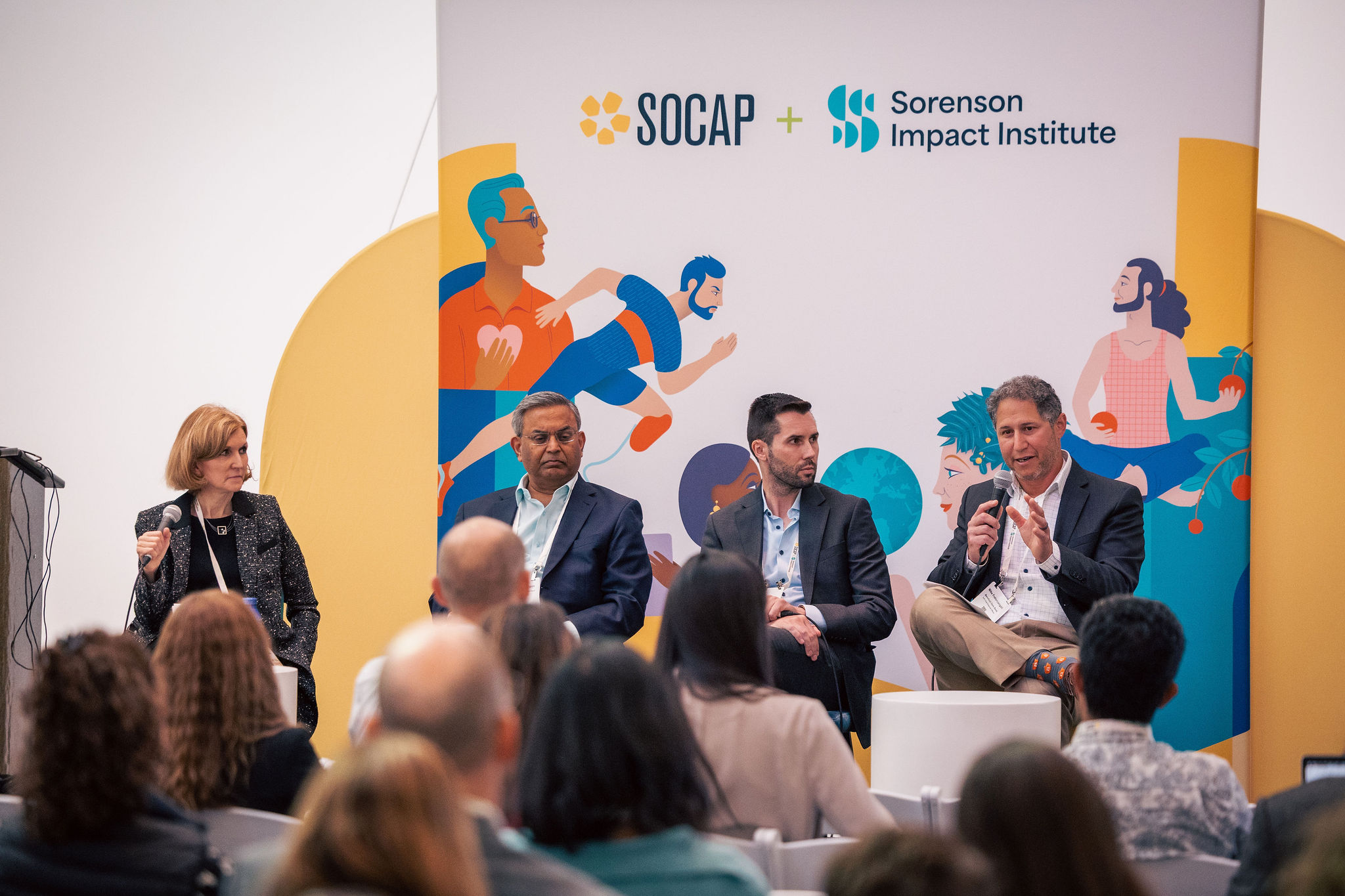
This conversation, recorded live at SOCAP25 and created from a session submitted through SOCAP Open by the U.S. Treasury, explores how one federal initiative helped unlock new lending capacity for Community Development Financial Institutions (CDFIs) and Minority Depository Institutions (MDIs) nationwide.
The discussion focused on the U.S. Treasury’s Emergency Capital Investment Program (ECIP), a pandemic-era initiative that provides long-term growth capital to community-focused banks and credit unions serving low-income and historically excluded communities. While the program emerged during the economic disruption of COVID-19, panelists argued its implications extend far beyond crisis response.
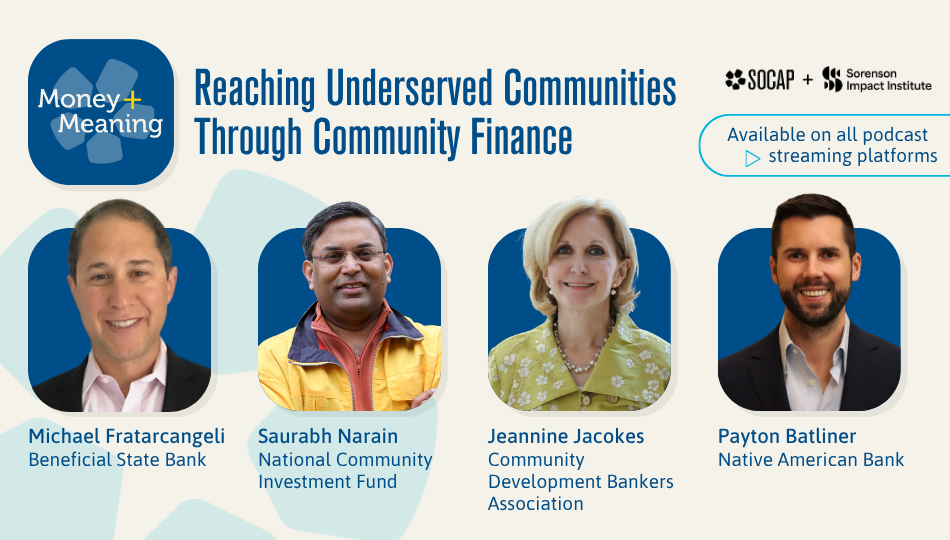
The conversation features:
- Jeannine Jacokes, CEO, Community Development Bankers Association (moderator)
- Payton Batliner, Chief Lending Officer & SVP, Native American Bank
- Michael Fratarcangeli, CFO, Beneficial State Bank
- Saurabh Narain, President & CEO, National Community Investment Fund
Together, they explore what happens when mission-driven lenders gain access to patient capital, and how those investments are helping finance affordable housing, healthcare facilities, tribal infrastructure, small businesses, and other community priorities often overlooked by traditional finance.
A Rare Example of Public Investment Unlocking Private Capital
Panelists repeatedly described ECIP as unusual, not just because of its size, but because of its structure. The program provided long-term, low-cost capital to mission-driven banks and credit unions, enabling them to scale lending in communities that have historically struggled to access investment.
For many institutions, the impact was immediate. Payton Batliner said Native American Bank nearly doubled in size after receiving ECIP funding, while Michael Fratarcangeli described the program as transformational for Beneficial State Bank’s long-term growth plans.
“This is the single largest gift partnership between the public sector and the private sector for the purpose of creating impact,” said National Community Investment Fund’s Saurabh Narain.
The Perception of Risk Still Shapes Access to Capital
One of the clearest themes throughout the conversation was that underserved communities are often viewed as inherently riskier by traditional financial institutions, even when the data suggests otherwise. Panelists argued that this perception gap continues to limit investment in low-income communities, tribal nations, and historically excluded borrowers. Yet many CDFIs report strong repayment histories and long-term stability precisely because they are deeply embedded in the communities they serve.
Speaking about lending in tribal communities, Batliner argued that many assumptions about risk simply don’t align with reality. Tribal governments, he noted, are highly motivated to protect essential infrastructure projects tied to healthcare, utilities, and community services. “When we’re lending to a tribal government or tribal program, the default rate is zero,” he said.
“The difference between perceived and actual risk is very small,” added Narain.
Using Capital to Expand What Community Finance Can Do
The conversation also highlighted how mission-driven banks are using ECIP capital differently than traditional growth capital. Rather than pursuing growth for its own sake, panelists described using the funding to finance projects that are often difficult to support solely through conventional banking: affordable housing, tribal healthcare facilities, community infrastructure, and lending programs designed to help borrowers improve long-term financial stability. “We’re not trying to grow for growth’s sake,” said Fratarcangeli. “We’re trying to grow because of impact.”
At Native American Bank, ECIP funding helped support complex infrastructure and healthcare projects in tribal communities, including a $44 million healthcare development that combined New Markets Tax Credits, USDA guarantees, and participation from multiple CDFIs. Batliner described the funding as allowing Native American Bank to “punch above our weight” by participating in larger, more complex projects that previously would have been difficult for the institution to support on its own.
Meanwhile, Fratarcangeli described expanding programs in affordable housing and auto refinancing, including efforts to help borrowers refinance high-interest car loans into more manageable payments. The broader goal, panelists said, is not simply to grow institutions but to expand economic opportunity in places that traditional finance often overlooks.

The Bigger Bottleneck May Be Deposits
While ECIP provided critical investment capital, several speakers emphasized that capital is not enough to scale community finance. Panelists noted that deposits are what allow banks to continue deploying capital into communities over time, and where people choose to bank can shape what kinds of projects ultimately get funded. “You’re almost stating your values with where you put your money,” said Fratarcangeli.
Narain encouraged impact-focused investors, foundations, and individuals to think differently about where they hold cash reserves, arguing that deposits themselves can serve as impact investments when placed with CDFIs and Minority Depository Institutions. “We need to make sure that every cent of our deposit goes into CDFI minority banks,” he said.
Panelists also stressed that stable, patient deposits are especially important for long-term community projects, which often take years to structure and complete.
Building Trust Through Results
Part of what makes programs like ECIP significant, panelists argued, is that they create an opportunity for community finance institutions to demonstrate what they can achieve at greater scale. That includes not only delivering measurable impact, but proving that mission-driven lending can operate sustainably over the long term. Panelists repeatedly emphasized that CDFIs are not charity organizations; they are regulated financial institutions balancing impact goals with risk management and financial performance.
For investors, that combination may become increasingly important as demand grows for financial models that can deliver both community impact and institutional stability.
Political Uncertainty Is Creating New Challenges
Even as panelists celebrated the success of ECIP, the conversation was shaped by growing uncertainty about the future of federal support for CDFIs. Batliner described projects already waiting on delayed federal processes, including affordable housing and infrastructure deals that could not move forward without federal coordination. “We’re literally sitting on our hands, sitting on capital,” he said.
At the same time, panelists noted that CDFIs continue to receive bipartisan support in Congress, creating a complicated and uncertain environment for the sector moving forward. Rather than retreating, several speakers framed the current moment as a test of whether mission-driven financial institutions can continue evolving, scaling, and proving their long-term value, even amid political and economic volatility.
Listen to the episode for the full discussion:
Don’t miss out! Subscribe to Money + Meaning on Apple Podcasts, Stitcher, TuneIn, Spotify, YouTube, or anywhere else you find podcasts.
Listen to more episodes of Money + Meaning here.